Physics · Ch 10 — Thermal Properties of Matter
Measurement of Temperature
Measurement of Temperature
The Idea of Temperature Measurement
Temperature is a measure of how hot or cold an object is. But to measure it quantitatively, we need a device that exploits a physical property that changes predictably with temperature. The simplest such property is thermal expansion — most substances expand when heated and contract when cooled.
A thermometer is any device that measures temperature by monitoring a thermometric property (a property that varies linearly with temperature over a useful range). The most familiar example is the liquid-in-glass thermometer, where a liquid (usually mercury or coloured alcohol) expands up a narrow capillary tube as temperature rises.
Calibrating a Thermometer: the Fixed Points
To turn this expansion into a usable numerical scale, a thermometer must be calibrated against two reproducible reference temperatures, called fixed points:
- The ice point — the temperature of pure melting ice at standard atmospheric pressure.
- The steam point — the temperature of steam above boiling water at standard atmospheric pressure.
The thermometer is placed in melting ice, and the level of the liquid in the capillary is marked. It is then placed in steam above boiling water, and the level is marked again. The distance between the two marks is divided into a chosen number of equal divisions — this choice is what distinguishes one temperature scale from another.
The Celsius Scale
On the Celsius scale, the ice point is taken as and the steam point as . The interval between the two fixed points is divided into 100 equal divisions, so each division corresponds to one degree Celsius.
The Fahrenheit Scale
The Fahrenheit scale (°F) is still used in some countries. Its fixed points are:
- Ice point: 32 °F
- Steam point: 212 °F
The interval between them is 180 °F (compared to 100 °C on the Celsius scale). So a change of 1 °C equals a change of 1.8 °F.
Relating the Celsius and Fahrenheit Scales …
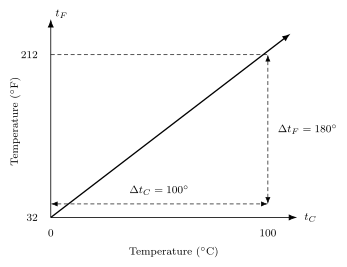
Drawn by us to help you understand the concept clearly, and verified to make sure it's accurate. For exams, practice from your textbook's own diagram.
The figure is a simple straight-line graph. On the horizontal axis (x-axis) we have Celsius temperature, , with the freezing point of water marked at and the boiling point at . On the vertical axis (y-axis) we have Fahrenheit temperature, , with the corresponding freezing point at and boiling point at . The graph itself is a single straight line that passes through these two points.
The physical idea is that the Celsius and Fahrenheit scales are linearly related. They are both based on the same two fixed points — the freezing and boiling temperatures of water at standard atmospheric pressure — but they use different intervals and different zero points. The line on the graph shows every possible pair of Celsius and Fahrenheit temperatures that correspond to the same physical hotness.
To see the relationship quantitatively, the textbook uses dashed guide lines. From the freezing point to the boiling point, the horizontal dashed line shows a change in Celsius temperature of . The vertical dashed line shows the corresponding change in Fahrenheit temperature of . This tells you that a temperature interval of 100 Celsius degrees spans the same physical change as an interval of 180 Fahrenheit degrees. The ratio of these intervals gives the slope of the line:
Since the line also passes through the point , the full equation relating the two scales is:
Here, is the temperature in degrees Fahrenheit, is the temperature in degrees Celsius, is the slope (the conversion factor for the size of a degree), and is the intercept (the Fahrenheit value when Celsius is zero).
A common mistake is to think the is added because water freezes at . That is true, but the deeper reason is that the two scales have different zero points. The is the vertical intercept of the line — it is the Fahrenheit reading when the Celsius reading is zero. If you ever forget the formula, you can reconstruct it from the two fixed points: the line through and . …