Physical Education · Ch 3 — Yoga as Preventive Measure for Lifestyle Disease
Uttanpadasan
Uttanpadasan
Uttanpadasana (Raised Leg Pose)
The name comes from the Sanskrit words Uttana, meaning raise-upward, and pada, meaning feet or legs. Uttanpadasana is one of the most useful asanas in yoga and carries many health benefits. It is also known as the Raised Leg Pose, because the legs are lifted upward while lying in a supine position. In the CBSE Class 12 Physical Education course it is taught as a preventive asana for hypertension.
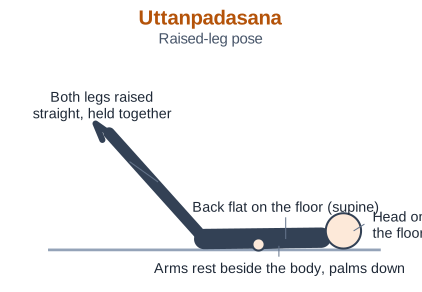
Drawn by us to help you understand the concept clearly, and verified to make sure it's accurate. For exams, practice from your textbook's own diagram.
Uttanpadasana (the Raised Leg Pose): the figure shows a person lying flat on the back with both legs held straight and lifted together off the floor at a controlled angle, arms resting flat by the sides with palms down for stability. Study the straight knees and the steady lower back, which stays close to the floor rather than arching, as the ke …
Technique
- Take a supine position with the legs together and the hands together by the sides of the body, palms resting on the ground.
- Raise both legs together slowly up to an angle of about 30 degrees.
- After a few seconds, raise them further to an angle of about 45 degrees.
- After a few more seconds, raise them up to about 60 degrees and hold the position there for a few seconds.
- While returning, stop again at 45 degrees and then at 30 degrees.
- Finally, bring both legs back down to the ground.
Benefits
- Very beneficial for those suffereing from diabetes, constipation, indigestion and nervous weakness.
- Balances the navel centre, the Nabhimanipurachakra.
- Builds up the abdominal muscles.
- Helps improve breathing and lung capacity.
Contraindications
- Avoid this posture if there is any injury in the neck, back, pelvis or leg muscles.
- Pregnant women should not perform this asana.
- People suffering from severe spondylitis, cardiac disease or abnormal blood pressure must refrain from it.
- Anyone who has undergone hernia-repair surgery should wait at least two weeks before practising it.
- If you have a migraine, then do not practice it.
Breathing Awareness
- Inhale while lying in the starting position, settling the body.
- Raise the legs on a slow exhalation at each stage (30°, 45°, 60°), rather than holding the breath while lifting.
- Breathe normally while holding each angle, and inhale again as the legs are lowered back down in stages.
Why Uttanpadasana helps manage hypertension
Lifting the legs against gravity while keeping the upper body relaxed on the floor works the deep abdominal muscles without raising the heart rate the way a standing exertion would, making it a relatively calm, controlled way to strengthen the core, useful for a hypertensive student who needs to avoid sudden, intense exertion. The asana is also believed to balance the navel-centre energy point described in the text (the Nabhimanipurachakra), and traditionally, postures that work the lower abdomen in a slow, controlled way are considered grounding and calming for the nervous system.
Common mistakes
- Raising both legs suddenly to the final angle, instead of pausing at each stage (30°, then 45°, then 60°), strains the lower back and defeats the gradual loading the technique is designed around. …