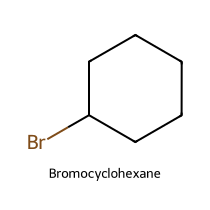
Q.Identify A, B, C, D, E, R and in the following: Bromocyclohexane, shown below,
You're viewing a preview — the full solution, concept, methods & PYQ mapping are locked.
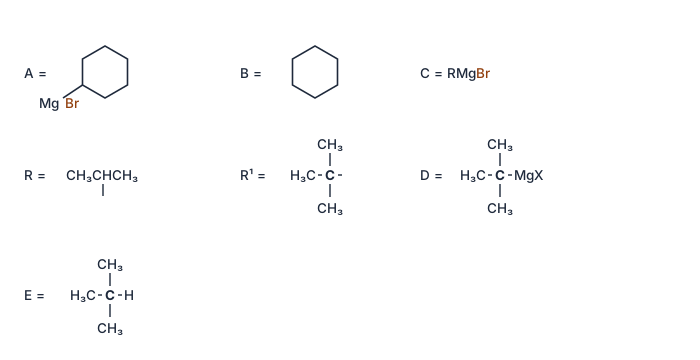
Start your 14-day free trial to unlock the full solution →This problem tests your understanding of Grignard reagents and Wurtz reaction. The key is to work backwards from the given products: B is cyclohexane, A is cyclohexylmagnesium bromide; R is isopropyl group, C is isopropylmagnesium bromide, and the product is deuterated propane; R¹ is tert-butyl group, X is Br, D is tert-butylmagnesium bromide, and E is 2-methylpropane (isobutane).
Let’s unpack the logic. The question gives you three separate reaction sequences, each built around the chemistry of Grignard reagents and the Wurtz reaction. The trick is to identify the unknown organic groups (R, R¹) and the intermediates (A through E) by reasoning backwards from the known products.
Why this approach works: Grignard reagents (R–Mg–X) are formed by reacting an alkyl/aryl halide with magnesium metal in dry ether. They act as strong nucleophiles and bases. When you quench them with water (H₂O) or heavy water (D₂O), you replace the MgX group with H or D, giving the corresponding alkane. The Wurtz reaction (2R–X + 2Na → R–R + 2NaX) couples two alkyl halides, but only works well for symmetrical, primary alkyl halides. By matching the products to these known reactions, we can deduce each unknown.
-
First sequence: Bromocyclohexane → A → B
Bromocyclohexane (C₆H₁₁Br) reacts with Mg in dry ether. This is the classic Grignard formation: the bromine is replaced by MgBr, giving A = cyclohexylmagnesium bromide (C₆H₁₁–Mg–Br).
When A is treated with water (H₂O), the Grignard reagent is protonated: the MgBr group is replaced by H. The product is B = cyclohexane (C₆H₁₂).
-
Second sequence: R–Br → C → CH₃CHDCH₃
Here, an unknown alkyl bromide R–Br forms a Grignard reagent C (R–Mg–Br). This is then quenched with D₂O (heavy water). The product is CH₃CHDCH₃ — that’s propane with one deuterium on the middle carbon.
The product tells us the structure of R. If the Grignard reagent R–Mg–Br is quenched with D₂O, the D ends up on the carbon that was bonded to Mg. So the product is R–D. Here, R–D = CH₃CHDCH₃, which means R must be the isopropyl group: CH₃CHCH₃ (with the free bond on the middle carbon). Therefore, R = isopropyl (CH₃)₂CH–, and C = isopropylmagnesium bromide, (CH₃)₂CH–Mg–Br.
TipThe deuterium label is a tracer: it lands exactly where the MgBr was. So the product’s structure directly reveals the original alkyl group R.
-
Third sequence: R¹–X → (CH₃)₃C–C(CH₃)₃ and R¹–X → D → E
This sequence has two branches from the same starting material R¹–X. …
Unlock everything free for 14 days
- Full step-by-step solutions
- Concept-first explanations
- Methods, shortcuts & mistakes
- PYQ mapping + timed mock tests
Full access for 14 days. No credit card required.