Q.Although chlorine is an electron withdrawing group, yet it is ortho-, para- directing in electrophilic aromatic substitution reactions. Why?
You're viewing a preview — the full solution, concept, methods & PYQ mapping are locked.
Start your 14-day free trial to unlock the full solution →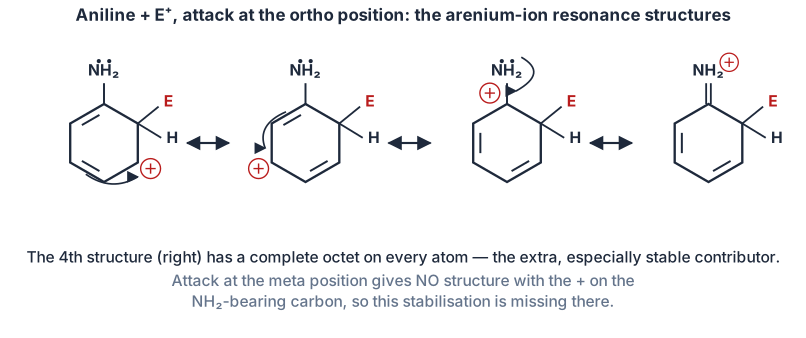
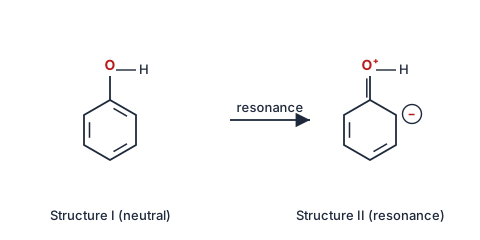
Chlorine is ortho-para directing because, despite its strong inductive electron withdrawal, it donates electrons through resonance by delocalising its lone pairs into the ring, stabilising the arenium ion intermediates formed at the ortho and para positions.
The question touches on a classic paradox in organic chemistry: how can a group that pulls electrons away from the ring (like chlorine) still direct incoming electrophiles to the ortho and para positions? The answer lies in the dual electronic effect of halogens — a tug-of-war between induction and resonance.
Let’s break this down.
-
The inductive effect of chlorine
Chlorine is highly electronegative. It pulls electron density towards itself through the sigma bond, making the ring slightly electron-deficient overall. This is an electron-withdrawing inductive effect (). If this were the only effect, chlorine would deactivate the ring and direct meta — like nitro or cyano groups do. But that’s not what happens.
-
The resonance effect of chlorine
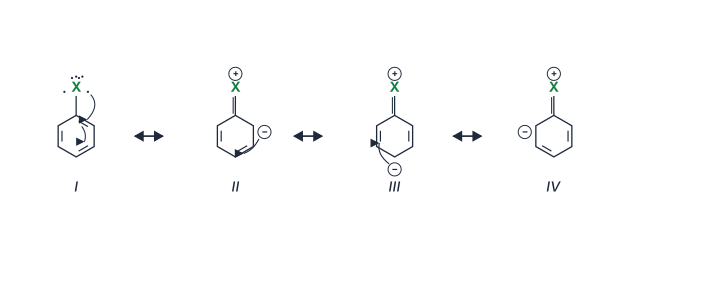
Chlorine has three lone pairs of electrons. One of these lone pairs can be donated into the pi system of the benzene ring through conjugation (resonance). This is a +R effect (or +M effect). The resonance structures show that the negative charge (or electron density) can be placed on the ortho and para carbons:
Resonance structures for chlorobenzene:
The lone pair from Cl forms a double bond with the ring, putting a negative charge on the ortho or para carbon.
This resonance donation partially counteracts the inductive withdrawal, especially at the ortho and para positions.
-
What happens during electrophilic attack?
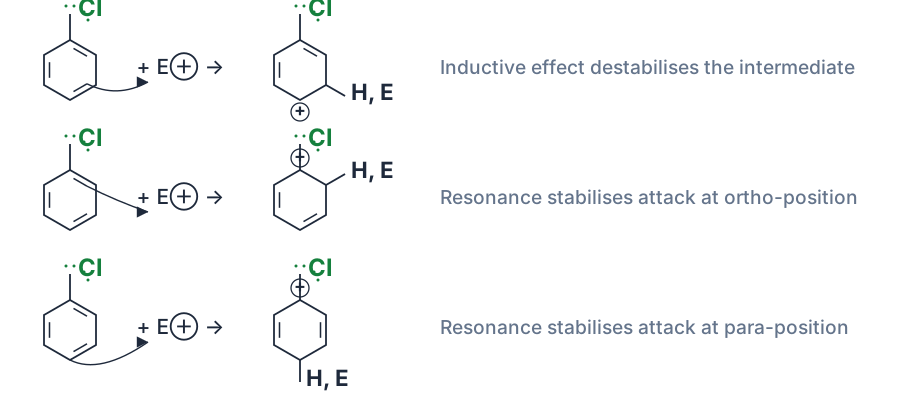
When an electrophile () attacks, a sigma complex (arenium ion) forms. The stability of this intermediate determines the regioselectivity. For chlorobenzene, the arenium ion can be stabilised by resonance from chlorine’s lone pair only if the attack occurs at the ortho or para position. Let’s see why:
- Ortho attack: The positive charge in the arenium ion can be delocalised onto the chlorine atom (which can donate its lone pair to form a double bond, giving a structure where chlorine bears a positive charge). This extra resonance contributor stabilises the intermediate.
- Para attack: Similarly, the positive charge can be delocalised to the para carbon, and then onto chlorine via resonance.
- Meta attack: The positive charge cannot be delocalised onto chlorine — the meta carbon is not directly conjugated with the chlorine’s lone pair. So the intermediate is less stabilised. …
Unlock everything free for 14 days
- Full step-by-step solutions
- Concept-first explanations
- Methods, shortcuts & mistakes
- PYQ mapping + timed mock tests
Full access for 14 days. No credit card required.