Applied Mathematics · Ch 5 — Differential Equations and Modeling
Newton's Law of Cooling
Newton's Law of Cooling
When a hot object is left in a cooler room — or a cold drink is left on a warm table — its temperature doesn't change at a constant rate; it changes fastest when the gap between the object and its surroundings is largest, and slows as the two temperatures converge. Newton's Law of Cooling captures this precisely: the rate of change of a body's temperature is proportional to the difference between and the temperature of the surrounding medium.
where is a constant. The sign of tells you the direction of change: if , the temperature is decreasing over time and the body is cooling; if , the temperature is increasing over time and the body is heating — in both cases, moves toward , never away from it. …
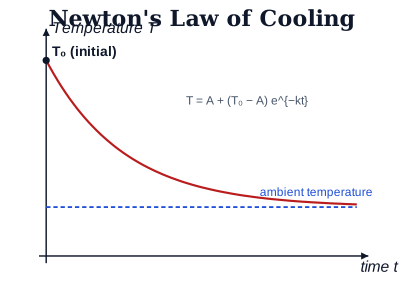
Drawn by us to help you understand the concept clearly, and verified to make sure it's accurate. For exams, practice from your NCERT textbook's own diagram.
Newton's law of cooling: the body's temperature approaches the ambient temperature over time, T = A …