Business Studies · Ch 2 — Principles of Management
Functional Foremanship
Functional Foremanship
In the factory system, the foreman is the person workers interact with face-to-face every day. As you have already studied, the foreman is the lowest-ranking manager and the highest-ranking worker — the pivot around whom all production planning, implementation, and control revolve. Taylor therefore focused intensely on improving the performance of this single role.
Taylor drew up a list of qualities a good foreman or supervisor must possess: intelligence, education, tact, grit, judgment, special knowledge, manual dexterity, energy, honesty, and good health. He concluded that no single person could possibly possess all these qualities. This realisation led him to propose functional foremanship — a system in which the work of one foreman is split among eight specialists.
The core idea behind functional foremanship is the separation of planning from execution. Taylor extended this principle all the way down to the lowest level of the shop floor. Under the factory manager, two separate in-charges were created: a planning in-charge and a production in-charge.
Under the planning in-charge, four personnel worked:
- Instruction card clerk — drafted written instructions for the workers.
- Route clerk — specified the exact route of production.
- Time and cost clerk — prepared time sheets and cost sheets.
- Disciplinarian — ensured discipline on the shop floor.
Under the production in-charge, four different personnel worked:
- Speed boss — responsible for timely and accurate completion of each job.
- Gang boss — kept machines, tools, and materials ready for the workers.
- Repair boss — ensured proper working condition of all machines and tools.
- Inspector — checked the quality of the finished work.
Each worker now had to take orders from all eight of these foremen, but only in relation to the specific function each foreman supervised. For example, a worker would follow the instruction card clerk's written instructions, the route clerk's production route, the speed boss's deadlines, and so on. …
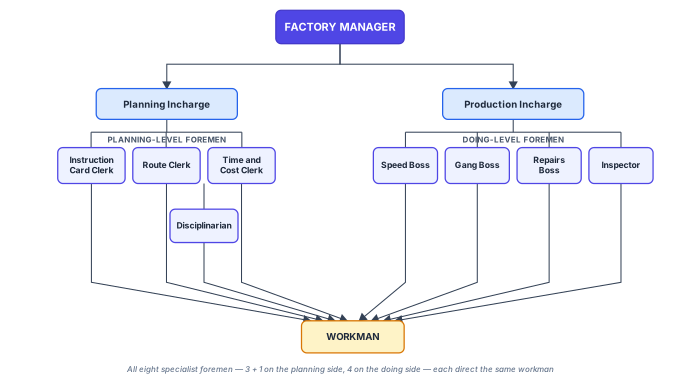
Taylor’s diagram of Functional Foremanship is a vertical organisational chart. At the very top sits the Factory Manager, the single overall authority. Directly below him, the chart splits into two parallel columns: the left column is headed Planning Incharge, the right column Production (Doing) Incharge. This split is the diagram’s central message — the complete separation of planning from execution, even at the shop-floor level.
Under the Planning Incharge, the chart shows four specialist foremen arranged in a row: Route Clerk, Instruction Card Clerk, Time-and-Cost Clerk, and Disciplinarian. Each has a distinct planning function — the Route Clerk decides the sequence of operations, the Instruction Card Clerk writes detailed work orders, the Time-and-Cost Clerk sets time standards and cost estimates, and the Disciplinarian enforces rules and discipline. Under the Production Incharge, another row of four specialists appears: Speed Boss, Gang Boss, Repairs Boss, and Inspector. Their roles are all execution-side — the Speed Boss ensures timely completion, the Gang Boss keeps tools and materials ready, the Repairs Boss maintains machines, and the Inspector checks quality.
At the very bottom of the chart, a single box labelled Workman receives arrows from all eight specialist foremen. This is the diagram’s most striking feature: one worker takes orders from eight different bosses, each an expert in one narrow function. The arrows flow downward from each specialist to the workman, showing that authority is not unified in one foreman but fragmented across eight functional heads.
The diagram teaches that Taylor rejected the traditional single foreman (who had to be a jack-of-all-trades) and instead applied division of work and specialisation to supervision itself. The worker now gets expert guidance in each aspect of production — but at the cost of reporting to eight people. …