Business Studies · Ch 2 — Principles of Management
Principles of Scientific Management
Principles of Scientific Management
The Problem with "Rule of Thumb"
Before Taylor, factory managers had no established theory to guide them. They ran their factories based on personal judgment and whatever had worked for them in the past. This approach is called rule of thumb. It allowed managers to handle problems as they came up, but it was essentially trial and error. The big limitation was that nobody could say for sure why something worked — so there was no reliable way to teach others or repeat success.
Taylor's Solution: Scientific Management
Frederick Winslow Taylor, who worked at the Bethlehem Steel Company, saw that this was not good enough. He argued that management should be based on the method of science: define the problem, develop alternatives, anticipate consequences, measure progress, and draw conclusions. He broke down human activity into small parts and studied how each part could be done more effectively, in less time, and with less waste. This is what he called scientific management.
In Taylor's own words: "Scientific management means knowing exactly what you want men to do and seeing that they do it in the best and cheapest way."
At Bethlehem Steel, applying these ideas led to a three-fold increase in productivity.
Taylor identified the core principles of scientific management. He also listed many specific techniques (like time studies, standardisation, and differential rates), but he called these "merely the elements or details of the mechanisms of management" — they were extensions of the principles, not the principles themselves.
The NCERT text's own Summary lists five principles of scientific management: Science, not Rule of Thumb; Harmony, not Discord; Cooperation, not Individualism; Maximum, not Restricted Output; and Development of each person to his or her greatest efficiency. The chapter's main discussion elaborates four of these under separate headings; "Maximum, not Restricted Output" is stated in the Summary and reflects Taylor's repeated insistence — in the sections on harmony and on the differential wage system — that output should be maximised rather than restricted. All five are presented below.
The Principles of Scientific Management
1. Science, Not Rule of Thumb
Taylor insisted that there is one best method to do any job — the method that maximises efficiency. This method is not discovered by guesswork. It is developed through systematic study and analysis.
The scientific method works like this:
- Investigate traditional methods through work-study.
- Unify the best practices from different approaches.
- Develop a single standard method to be followed throughout the organisation.
Even a simple task like loading pig iron into boxcars could be scientifically planned. Taylor showed that this could save huge amounts of human energy, time, and materials. The more complex the process, the greater the savings. In today's world, the use of the Internet to improve internal efficiency and customer satisfaction is a modern example of the same principle.
2. Harmony, Not Discord
The factory system created a natural tension: managers had to get work done from workers, and this often led to a class conflict — managers versus workers. Taylor recognised that this conflict helped nobody — not the workers, not the managers, and not the owners.
He called for a complete mental revolution on the part of both management and workers. Both sides had to change their thinking. Management should share the company's gains with workers. Workers, in turn, should work hard and be willing to embrace change for the good of the company. Both should see themselves as part of one family.
Taylor wrote: "Scientific management has for its foundation the firm conviction that the true interests of the two are one and the same; that prosperity for the employer cannot exist for a long time unless it is accompanied by prosperity for the employees and vice versa."
The Japanese work culture is a classic example. In Japanese companies, there is a paternalistic style of management — complete openness between management and workers. Even when workers go on strike, they wear a black badge but work more than normal hours to gain the management's sympathy.
3. Cooperation, Not Individualism
This principle is an extension of the previous one. Competition between labour and management should be replaced by cooperation. Both sides must realise they need each other.
For this to happen:
- Management should not ignore constructive suggestions from employees.
- Workers should be rewarded for suggestions that reduce costs.
- Workers should be taken into confidence before important decisions are made.
- Workers should avoid strikes and unreasonable demands.
When there is open communication and goodwill, there may be no need for a trade union at all. Taylor believed there should be an almost equal division of work and responsibility between management and workers. Management should work side by side with workers all day — helping, encouraging, and smoothing the way for them.
4. Maximum Output, Not Restricted Output
Taylor was firmly against any deliberate restriction of output. He argued that both management and workers should give up the habit of holding back — workers fearing that higher output would cost jobs or wages, and managers hoarding the gains. Instead, both sides should aim to maximise output and enlarge the surplus that is then shared, rather than quarrelling over how to divide a small, restricted output. Continuously increasing production is in the interest of the employer, the employee and society alike.
5. Development of Each and Every Person to His or Her Greatest Efficiency and Prosperity …
The following extracts are taken from Taylor's testimony before the U.S. House of Representatives Special Committee in 1912 and also from his most important work "THE PRINCIPLES OF SCIENTIFIC MANAGEMENT" published in 1911.
"Scientific management requires first, a careful investigation of each of the many modifications of the same implement, developed under rule of thumb; and second, after time and motion study has been made of the speed attainable with each of these implements, that the good points of several of them shall be unified in a single standard implementation, which will enable the workman to work faster and with greater ease than he could before. This one implement, then is adopted as standard in place of the many different kinds before in use and it remains standard for all workmen to use until superseded by an implement which has been shown, through motion and time study, to be still better." (Scientific Management, page 119)
The main elements of Scientific Management are (page 129–130, Scientific Management):
- Time Studies
- Functional or specialised supervision
- Standardisation of tools and implements
- Standardisation of work methods
- Separate Planning function
- Management by exception principle
- The use of 'slide-rules and similar time-saving devices'
- Instruction cards for workmen
- Task allocation and large bonus for successful performance
- The use of the 'differential rate'
- Mnemonic systems for classifying products and implements
- A routing system
- A modern costing system, etc.
Taylor called these elements "merely the elements or details of the mechanisms of management." He saw them as extensions of the four principles of management (page 130, Scientific Management): …
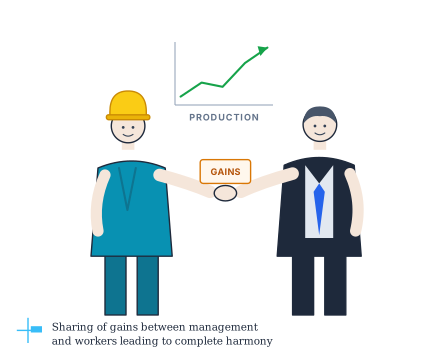
Drawn by us to help you understand the concept clearly, and verified to make sure it's accurate. For exams, practice from your NCERT textbook's own diagram.
What the Figure Shows
Our own schematic shows a factory worker (hard hat, blue overalls) and a manager (dark suit) facing each other, shaking hands. A small "GAINS" token passes between them, and a simple rising line chart labelled PRODUCTION sits in the background, showing output trending upward.
What It Teaches
It illustrates Taylor's principle of Harmony, Not Discord — the second of the four principles of scientific management. Taylor recognised that a factory always carries the possibility of class conflict between managers and workers, and that this conflict helps no one. His answer was that management should share the gains of the company, if any, with the workers, while workers in turn work hard and embrace change for the good of the company — both sides realising that each is important, so that prosperity for the employer cannot last unless it is accompanied by prosperity for the employees, and vice versa. Taylor pointed to Japanese work culture, where paternalistic management and openness between management and workers kept this harmony alive even during a strike. This principle sits alongside Taylor's other three techniques for building cooperation — Cooperation, Not Individualism and **Menta …