Physical Education · Ch 6 — Test and Measurement in Sports
Plate Tapping Test
Plate Tapping Test
Purpose
The Plate Tapping Test measures the speed and coordination of limb movement — how quickly the preferred hand can move back and forth between two targets.
Infrastructure / Equipment Required
- A table of adjustable height.
- Two yellow discs, each 20 cm in diameter.
- A rectangle measuring 30 cm × 20 cm.
- A stopwatch.
Layout
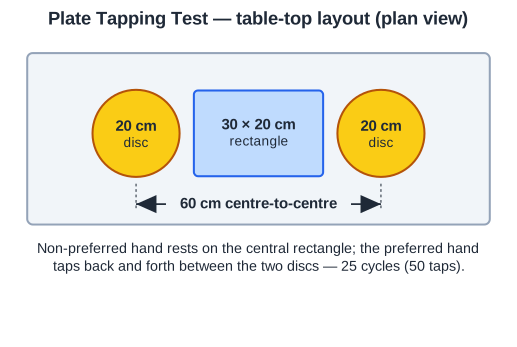
Drawn by us to help you understand the concept clearly, and verified to make sure it's accurate. For exams, practice from your NCERT textbook's own diagram.
Top-down plan of the plate-tapping table surface: two yellow discs (20 cm diameter) with their centres 60 cm apart, and a 30 cm x 20 cm rectangle placed exactly midway between them. The non-preferred hand rests on the central rectangle while the preferred h …
Procedure
If possible, adjust the table height so the subject stands comfortably in front of the discs. Place the two yellow discs on the table with their centres 60 cm apart, and set the rectangle exactly midway between them. The subject rests the non-preferred hand on the rectangle, then moves the preferred hand back and forth between the two discs, passing over the middle hand, as quickly as possible. This is repeated for 25 full cycles (50 taps in all).
Scoring
The time taken to complete the 25 cycles is recorded. A shorter time indicates faster limb movement and better coordination.
Why It Matters (Physiological Rationale)
Moving a hand quickly and accurately between two fixed targets depends on fast nerve-to-muscle signalling, simple reaction time, and the ability of the eyes and hand to work together. Together these make up "coordination," one of the key motor-fitness components alongside balance, agility, power and speed. Because children aged 5-8 are still developing these neuromuscular pathways, a coordination test is used here instead of a strength test.
Benefits of Regular Testing
- Gives teachers an early, simple read on a child's hand-eye coordination, long before sport-specific skills are introduced.
- Highlights children who may benefit from extra coordination-building activities (ball games, catching drills) before they begin organised sport.
- Is quick to administer to a whole class with minimal equipment, which is why it was chosen for the youngest age band of the Khelo India battery.
Common Mistakes & Precautions
- Letting the non-preferred hand lift off the rectangle invalidates the trial; it must stay flat on the rectangle throughout.
- Counting a "tap" that misses the disc; only a tap that actually lands on the disc should count towards the 25 cycles.
- Starting the stopwatch before the subject is ready, or stopping it late, distorts the recorded time; start exactly on the first disc contact.
- Not adjusting the table height for a young child's reach forces an awkward posture and slows the result for reasons unrelated to real coordination. …