Physical Education · Ch 6 — Test and Measurement in Sports
Sit and Reach
Sit and Reach
Purpose
The Sit and Reach Test is a common measure of flexibility, and specifically of the flexibility of the lower back and hamstring muscles. It matters because tightness in this area is linked with lumbar lordosis, forward pelvic tilt and lower back pain.
Infrastructure / Equipment Required
- A Sit and Reach box with these dimensions: 12 in × 12 in (sides), 12 in × 10 in (front and back) and 12 in × 21 in (top). The top panel is marked with centimetre/millimetre gradations, and the vertical plane against which the subject's feet rest must be exactly at the 23 cm mark.
- A flat, clean, cushioned surface or gym mats.
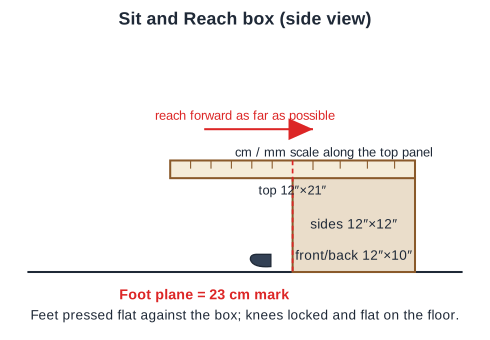
Drawn by us to help you understand the concept clearly, and verified to make sure it's accurate. For exams, practice from your NCERT textbook's own diagram.
A labelled diagram of the Sit and Reach box showing its dimensions (top 12 in x 21 in, sides 12 in x 12 in, front and back 12 in x 10 in), the centimetre/millimetre measuring scale along the top panel, and the foot plane set exactly at the 23 cm mark whe …
Procedure
The subject sits on the floor with the legs stretched straight ahead and shoes removed, and places the soles of the feet flat against the Sit and Reach box. Both knees are locked and pressed flat to the floor — the tester may help by holding them down. With the palms facing down and the hands placed one on top of the other, the subject reaches forward along the measuring line as far as possible, keeping both hands level so neither reaches further than the other. After a few practice reaches, the subject reaches out and holds the farthest position for one to two seconds while the distance is recorded. There should be no jerky movements.
Scoring
The score is the distance reached by the hand, recorded in centimetres and millimetres as the difference between the initial position and the final position.
Why It Matters (Physiological Rationale)
The hamstrings cross both the hip and the knee, and when they are tight they pull on the pelvis, tilting it forward and increasing the curve of the lower back (lumbar lordosis). The Sit and Reach Test loads the hamstrings and lower back together, with the knees locked straight, so any restriction in either structure directly limits how far the subject can reach.
Benefits of Regular Testing
- Identifies tight hamstrings and a stiff lower back before they contribute to postural problems or back pain.
- Flexibility measured this way is directly trainable through a regular stretching routine, so retesting periodically is a practical way to track progress.
- The test is quick, needs only a simple box, and can be run on an entire class in a single period.
Common Mistakes & Precautions
- Letting the knees bend during the reach, which shortens the true hamstring stretch and produces an inflated score; the tester should hold the knees down if needed.
- Bouncing to gain extra distance rather than reaching smoothly and holding; bouncing risks a hamstring strain and does not represent a true, sustained range of motion. …