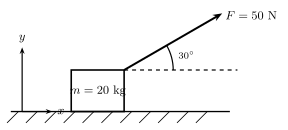
Q.A force of 50 N acts on an object of mass 20 kg, directed at 30∘ above the horizontal (x) direction, as shown in the figure. Calculate the acceleration of the object along the x and y directions.
Newton's Second Law: The Law That Connects Force and Motion
Imagine you're pushing a shopping cart. If you push gently, it moves slowly. Push harder, and it speeds up faster. Now imagine the cart is full of groceries — even with the same push, it accelerates much more slowly than an empty cart. This everyday experience is exactly what Newton's Second Law captures.
The Intuition First
Two things matter when you push something:
How hard you push — the force you apply.
How heavy the object is — its mass.
The harder you push, the more the object speeds up. The heavier the object, the less it speeds up for the same push. So acceleration depends on both force and mass — and in opposite ways.
Note
"Acceleration" here means any change in velocity — speeding up, slowing down, or changing direction. It's not just "going faster."
The Precise Statement
Newton's Second Law says:
The acceleration of an object is directly proportional to the net force acting on it, and inversely proportional to its mass. The acceleration is in the same direction as the net force.
In one equation:
a=mFnet
Or more commonly:
Fnet=ma
Where:
Fnet is the net force (the vector sum of all forces acting on the object) — measured in newtons (N)
m is the mass of the object — measured in kilograms (kg)
a is the acceleration — measured in metres per second squared (m/s2)
Fnet=ma
What This Really Means
Force causes acceleration, not velocity. A constant net force produces constant acceleration — meaning the velocity keeps changing at a steady rate. If you stop pushing, the net force becomes zero, and acceleration becomes zero (the object continues at constant velocity — that's Newton's First Law).
Mass is a measure of inertia. The more mass an object has, the harder it is to change its motion. A truck needs a much larger force than a bicycle to achieve the same acceleration.
Direction matters. Force and acceleration are vectors — they point the same way. If you push north, the acceleration is north. If multiple forces act, you must add them as vectors to find the net force.
A Simple Example
A 2 kg block is pushed with a net force of 10 N to the right.
a=mFnet=2kg10N=5m/s2
The block accelerates at 5m/s2 to the right. Every second, its velocity increases by 5 m/s in that direction.
Watch out
A common mistake: thinking that a constant force means constant velocity. It doesn't — constant force means constant acceleration, so velocity keeps changing. Only when net force is zero does velocity stay constant.
Why This Law Is So Powerful
Newton's Second Law is the bridge between forces (the causes) and motion (the effects). It lets you:
Predict how an object will move if you know the forces on it
Calculate the force needed to produce a desired motion
Understand why heavier things are harder to accelerate
It applies everywhere — from a ball you throw to a rocket launching into space. The same law governs them all.
For quick revision, remember that Newton Second Law is drawn directly from the Laws of Motion coverage of the NCERT/CBSE Class 11 Physics syllabus and recurs often in JEE Main and NEET papers, which is exactly why "Newton Second Law important questions" shows up so often in Physics question banks. The clearest way to build exam confidence here is to combine this explanation with the NCERT Physics textbook's own solved examples and chapter-end questions.
Figurea 20 kg block pulled by a 50 N force acting at 30 degrees above the horizontal — Class 12 Physics question
Resolve the 50 N force into x and y components, then divide each by the mass to get the two acceleration components.
✓Final answer
ax≈2.165 m s−2, ay=1.25 m s−2.
Figurea 20 kg block pulled by a 50 N force acting at 30 degrees above the horizontal — Class 12 Physics question
Step 1. Resolve F=50 N into components at 30° to the x-axis: Fx=Fcos30°=50×0.866=43.3 N; Fy=Fsin30°=50×0.5=25 N.
Step 2. Apply Newton's second law along the x-axis: ax=mFx=2043.3=2.165 m s−2.
Step 3. Apply Newton's second law along the y-axis: ay=mFy=2025=1.25 m s−2.
✓Final answer
ax=2.165 m s−2 and ay=1.25 m s−2.
Resolve F into perpendicular components, then apply a = F/m independently along each axis.
Using sin where cos is needed (or vice versa) when resolving the force, depending on which axis the 30° is measured from.
Adding the components instead of finding each axis's acceleration separately.