Mathematics · Ch 7 — Applications of Differential Calculus
Derivative as Slope
Derivative as Slope
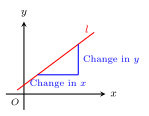
Slope of a line. For a non-vertical line , take any horizontal segment starting on and the vertical segment from its end back to ; the ratio (vertical length)/(horizontal length) is always the same constant, called the slope of the line. A line is increasing if , decreasing if , and constant (horizontal) if . The equation is exactly the line of slope and -intercept .
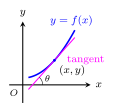
Slope of a curve. For a curve , the line joining and has slope
Letting gives the slope of the curve at the point itself:
If is the angle the tangent to at makes with the -axis (measured anticlockwise), then . Because of this, is also written and called the instantaneous rate of change; the average rate of change over an interval is the ordinary Newton quotient (a chord slope) over that interval. …
Drawn by us to help you understand the concept clearly, and verified to make sure it's accurate. For exams, practice from your textbook's own diagram.
What this figure shows. A straight line l in the XY-plane with a horizontal 'Change in x' leg and a vertical 'Change in y' leg forming a right triangle, illustrating that slope is the constant ratio of vertical chang …
Drawn by us to help you understand the concept clearly, and verified to make sure it's accurate. For exams, practice from your textbook's own diagram.
What this figure shows. The curve y = f(x) with its tangent line at the point (x, y), the angle theta the tangent makes with the x-axis, showing the slope of a curve equ …