Mathematics · Ch 9 — Applications of Integration
Volume of a Solid Obtained by Revolving Area About an Axis
Volume of a Solid Obtained by Revolving Area About an Axis
Solids of revolution. When a plane region is given one complete rotation ( radians) about a fixed axis lying in its own plane, it sweeps out a solid of revolution. For example, revolving the semicircular region enclosed by above the -axis about the -axis generates a sphere of radius ; revolving the rectangular region bounded by about the -axis generates a right-circular cylinder of radius and height .
This section restricts to revolution about the -axis or the -axis. For revolution about the -axis, the revolved plane region lies above the -axis (); for revolution about the -axis, it lies to the right of the -axis ().
Derivation (disc method), about the -axis. Let , -axis, () bound a region in the first quadrant, with every vertical line between and meeting the curve exactly once. Divide into segments , . On each subinterval, the thin rectangle of height and width , revolved about the -axis, sweeps out an elementary cylindrical disc of radius and height , hence volume (using "volume of a cylinder "). Summing all the discs, , and letting , this tends to the volume of the whole solid:
By the identical argument with and interchanged, for a curve , -axis, and revolved about the -axis,
Standard solids re-derived by these formulas (Examples 9.62-9.69), all worth having on hand as checks:
- Sphere of radius : revolve , , about the -axis: .
- Right circular cone, base radius , height : revolve the triangular region under , , about the -axis: .
- Spherical cap of height cut from a sphere of radius : revolve , , about the -axis: ; in terms of the cap's own base radius (where ), .
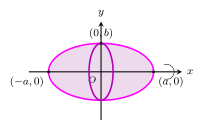
- Ellipsoid, from the ellipse () revolved about the major axis (-axis): ; revolved about the minor axis (-axis) instead: . …
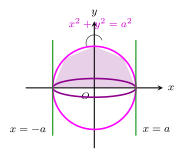
Drawn by us to help you understand the concept clearly, and verified to make sure it's accurate. For exams, practice from your textbook's own diagram.
What this figure shows. The upper semicircular region inside x^2+y^2=a^2 above the x-axis, bounded by x=-a and x=a, which when revolved one full turn about the x-axis gene …
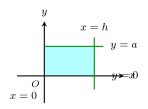
Drawn by us to help you understand the concept clearly, and verified to make sure it's accurate. For exams, practice from your textbook's own diagram.
What this figure shows. The rectangular plane region bounded by y=0, y=a, x=0 and x=h which, when revolved one full turn about the x-axis, generates a right-circular cylinder of radiu …
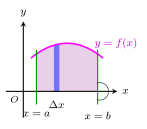
Drawn by us to help you understand the concept clearly, and verified to make sure it's accurate. For exams, practice from your textbook's own diagram.
What this figure shows. The plane region under y=f(x) between x=a and x=b, with one elementary vertical strip of width delta x, revolved about the x-axis to form a thin cy …
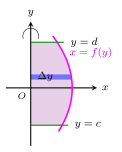
Drawn by us to help you understand the concept clearly, and verified to make sure it's accurate. For exams, practice from your textbook's own diagram.
What this figure shows. The plane region bounded by x=f(y), the y-axis and the lines y=c and y=d, with one elementary horizontal strip of width delta y, revolved abou …
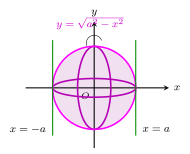
Drawn by us to help you understand the concept clearly, and verified to make sure it's accurate. For exams, practice from your textbook's own diagram.
What this figure shows. The semicircular region bounded by y=sqrt(a^2-x^2) and the x-axis between x=-a and x=a revolved about the x-axis to generate a sphere of radius a, drawn with meridian and equato …
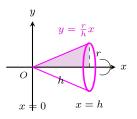
Drawn by us to help you understand the concept clearly, and verified to make sure it's accurate. For exams, practice from your textbook's own diagram.
What this figure shows. The triangular region in the first quadrant bounded by y=(r/h)x, the x-axis and x=h, revolved about the x-axis to generate a right-circular cone of base radius …
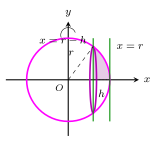
Drawn by us to help you understand the concept clearly, and verified to make sure it's accurate. For exams, practice from your textbook's own diagram.
What this figure shows. The region in the first quadrant bounded by the circle x^2+y^2=r^2, the x-axis and the lines x=r-h and x=r, revolved about the x-axis to generate a spherical …
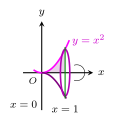
Drawn by us to help you understand the concept clearly, and verified to make sure it's accurate. For exams, practice from your textbook's own diagram.
What this figure shows. The region bounded by the parabola y=x^2, the x-axis and the ordinates x=0 and x=1, revolved about the x-axis to generate a parabol …
Drawn by us to help you understand the concept clearly, and verified to make sure it's accurate. For exams, practice from your textbook's own diagram.
What this figure shows. The region bounded by the ellipse x^2/a^2 + y^2/b^2 = 1 (a>b) revolved about the major axis (x-axis) to generate a prolate ellipsoid; vertices (a,0), (- …
Drawn by us to help you understand the concept clearly, and verified to make sure it's accurate. For exams, practice from your textbook's own diagram.
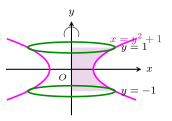
What this figure shows. The region bounded by the parabola x=y^2+1, the y-axis and the lines y=1 and y=-1, revolved about the y-axis to generate a solid of …
Drawn by us to help you understand the concept clearly, and verified to make sure it's accurate. For exams, practice from your textbook's own diagram.
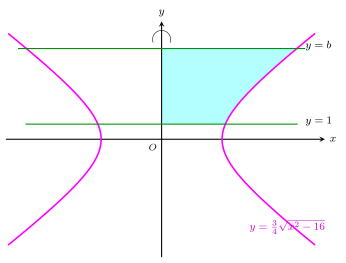
What this figure shows. The region bounded by the hyperbola portion y=(3/4)sqrt(x^2-16) (that is x^2/16 - y^2/9 = 1), the y-axis and the lines y=1 and y=6, revolved abo …
Drawn by us to help you understand the concept clearly, and verified to make sure it's accurate. For exams, practice from your textbook's own diagram.
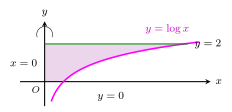
What this figure shows. The region bounded by the curve y=log x, the lines y=0, x=0 and y=2, revolved about the y-a …
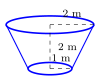
Drawn by us to help you understand the concept clearly, and verified to make sure it's accurate. For exams, practice from your textbook's own diagram.
What this figure shows. A container in the shape of a right-circular conical frustum with top radius 2 m, bottom radius 1 m and height 2 m (Exercise …