Mathematics · Ch 6 — Applications of Vector Algebra
Application of Dot and Cross Product in Physics
Application of Dot and Cross Product in Physics
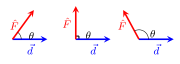
Definition 6.2 (Work). If a constant force acts on a particle while it is displaced by (from one point to another), the work done by the force is
Since , the work is positive when the force has an acute angle with the displacement, zero when perpendicular, and negative when obtuse. When several forces act together, first find their resultant (vector sum) and dot that resultant with the displacement (Example 6.9: forces and resolve to ; with displacement from to , the work comes out to units). If the displacement's endpoint carries an unknown (Example 6.10), setting equal to the given work done yields a linear equation for the unknown.
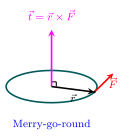
Definition 6.3 (Torque/Moment). If a force acts on a particle at a point with position vector relative to the point about which the turning effect is measured, the torque (or moment, also called the rotational force) is
Being a cross product, torque is a vector, perpendicular to the plane of and ; its magnitude measures the turning strength, and its direction cosines (found from ) describe the axis about which the force tends to rotate the body — this is exactly the everyday idea of a merry-go-round or a wrench turning a bolt (Example 6.11: force through the origin, torque taken about , giving , magnitude ). …
Drawn by us to help you understand the concept clearly, and verified to make sure it's accurate. For exams, practice from your textbook's own diagram.
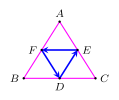
What this figure shows. Fig. 6.13 - Triangle ABC with D, E, F the midpoints of the sides forming the medial triangle DEF, whose area is one-fourth the a …
Drawn by us to help you understand the concept clearly, and verified to make sure it's accurate. For exams, practice from your textbook's own diagram.
What this figure shows. Fig. 6.14 - Work done by a force F-hat acting at an acute angle, a right angle and an obtuse angle to the displacement d, giving positive, zero and negative wo …
Drawn by us to help you understand the concept clearly, and verified to make sure it's accurate. For exams, practice from your textbook's own diagram.
What this figure shows. Fig. 6.15 - Torque as a rotational force t = r x F illustrated on a merry-go-round: r is the position vector (radius), F the applied force in the plane of the disc, and the torque t points al …

Drawn by us to help you understand the concept clearly, and verified to make sure it's accurate. For exams, practice from your textbook's own diagram.
What this figure shows. Fig. 6.16 - Torque about the point A(2,0,-1) of a force F whose line of action passes through the origin O; the position vector r = AO points …