Skip to content

Mathematics · Ch 6 — Applications of Vector Algebra

Application of Dot and Cross Products in Plane Trigonometry

6.3.2

Application of Dot and Cross Products in Plane Trigonometry

Dot and cross products give slick, purely algebraic proofs of several plane-trigonometry results, with usual triangle ABCABC notation (a=BC, b=CA, c=ABa=BC,\,b=CA,\,c=AB).

Cosine rule (Example 6.1). Since BC⃗+CA⃗+AB⃗=0⃗\vec{BC}+\vec{CA}+\vec{AB}=\vec 0, we get BC⃗=−CA⃗−AB⃗\vec{BC}=-\vec{CA}-\vec{AB}; dotting BC⃗\vec{BC} with itself and using CA⃗⋅AB⃗=∣CA∣∣AB∣cos⁡(π−A)\vec{CA}\cdot\vec{AB}=|CA||AB|\cos(\pi-A) (the angle between the vectors CA⃗\vec{CA} and AB⃗\vec{AB}, as drawn head-to-tail, is π−A\pi-A) gives a2=b2+c2−2bccos⁡Aa^2=b^2+c^2-2bc\cos A, and cyclically for B,CB,C.

Projection formula (Example 6.2): a=bcos⁡C+ccos⁡Ba=b\cos C+c\cos B, and cyclically — obtained the same way, dotting BC⃗\vec{BC} with itself but grouping differently.

Compound-angle identities (Examples 6.3 & 6.5, Exercise questions 9–10). Let a^=cos⁡α i^+sin⁡α j^\hat a=\cos\alpha\,\hat i+\sin\alpha\,\hat j and b^=cos⁡β i^+sin⁡β j^\hat b=\cos\beta\,\hat i+\sin\beta\,\hat j be unit vectors at angles α,β\alpha,\beta to the positive xx-axis. Then:

  • a^⋅b^=cos⁡αcos⁡β+sin⁡αsin⁡β\hat a\cdot\hat b=\cos\alpha\cos\beta+\sin\alpha\sin\beta is also ∣a^∣∣b^∣cos⁡(α−β)=cos⁡(α−β)|\hat a||\hat b|\cos(\alpha-\beta)=\cos(\alpha-\beta), giving cos⁡(α−β)=cos⁡αcos⁡β+sin⁡αsin⁡β\boxed{\cos(\alpha-\beta)=\cos\alpha\cos\beta+\sin\alpha\sin\beta}. Replacing b^\hat b by the unit vector at angle −β-\beta (i.e. cos⁡β i^−sin⁡β j^\cos\beta\,\hat i-\sin\beta\,\hat j) and redoing the dot product gives cos⁡(α+β)=cos⁡αcos⁡β−sin⁡αsin⁡β\cos(\alpha+\beta)=\cos\alpha\cos\beta-\sin\alpha\sin\beta.
  • Taking a^\hat a at angle −α-\alpha (below the axis) and b^\hat b at angle β\beta (above), a^×b^=(sin⁡αcos⁡β+cos⁡αsin⁡β)k^\hat a\times\hat b=(\sin\alpha\cos\beta+\cos\alpha\sin\beta)\hat k; since the angle swept from a^\hat a to b^\hat b is α+β\alpha+\beta, ∣a^×b^∣=sin⁡(α+β)|\hat a\times\hat b|=\sin(\alpha+\beta), giving sin⁡(α+β)=sin⁡αcos⁡β+cos⁡αsin⁡β\boxed{\sin(\alpha+\beta)=\sin\alpha\cos\beta+\cos\alpha\sin\beta}. The companion sin⁡(α−β)=sin⁡αcos⁡β−cos⁡αsin⁡β\sin(\alpha-\beta)=\sin\alpha\cos\beta-\cos\alpha\sin\beta follows the same way with both unit vectors above the axis. …
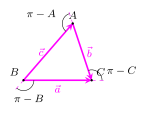
Figure 6.6Fig. 6.6 - Triangle ABC with sides as vectors BC = a, CA = b, AB = c and the exterior angles pi-A, pi-B, pi-C, used to prove the cosine formulae by vector method.
Fig. 6.6 — Fig. 6.6 - Triangle ABC with sides as vectors BC = a, CA = b, AB = c and the exterior angles pi-A, pi-B, pi-C, used to prove the cosine formulae by vector method.

Drawn by us to help you understand the concept clearly, and verified to make sure it's accurate. For exams, practice from your textbook's own diagram.

What this figure shows. Fig. 6.6 - Triangle ABC with sides as vectors BC = a, CA = b, AB = c and the exterior angles pi-A, pi-B, pi-C, used to prove the cosine formulae by …
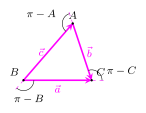
Figure 6.7Fig. 6.7 - Triangle ABC with sides as vectors BC = a, CA = b, AB = c and the exterior angles pi-A, pi-B, pi-C, used to prove the projection formulae by vector method.
Fig. 6.7 — Fig. 6.7 - Triangle ABC with sides as vectors BC = a, CA = b, AB = c and the exterior angles pi-A, pi-B, pi-C, used to prove the projection formulae by vector method.

Drawn by us to help you understand the concept clearly, and verified to make sure it's accurate. For exams, practice from your textbook's own diagram.

What this figure shows. Fig. 6.7 - Triangle ABC with sides as vectors BC = a, CA = b, AB = c and the exterior angles pi-A, pi-B, pi-C, used to prove the projection formulae b …
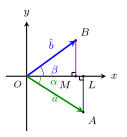
Figure 6.8Fig. 6.8 - Unit vectors a-hat = OA and b-hat = OB making angles alpha (below) and beta (above) with the positive x-axis, with feet L and M, used to prove cos(alpha+beta).
Fig. 6.8 — Fig. 6.8 - Unit vectors a-hat = OA and b-hat = OB making angles alpha (below) and beta (above) with the positive x-axis, with feet L and M, used to prove cos(alpha+beta).

Drawn by us to help you understand the concept clearly, and verified to make sure it's accurate. For exams, practice from your textbook's own diagram.

What this figure shows. Fig. 6.8 - Unit vectors a-hat = OA and b-hat = OB making angles alpha (below) and beta (above) with the positive x-axis, with feet L and M, used to prove …
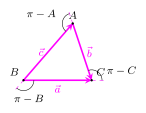
Figure 6.9Fig. 6.9 - Triangle ABC with sides as vectors BC = a, CA = b, AB = c and the exterior angles pi-A, pi-B, pi-C, used to prove the sine rule by vector method.
Fig. 6.9 — Fig. 6.9 - Triangle ABC with sides as vectors BC = a, CA = b, AB = c and the exterior angles pi-A, pi-B, pi-C, used to prove the sine rule by vector method.

Drawn by us to help you understand the concept clearly, and verified to make sure it's accurate. For exams, practice from your textbook's own diagram.

What this figure shows. Fig. 6.9 - Triangle ABC with sides as vectors BC = a, CA = b, AB = c and the exterior angles pi-A, pi-B, pi-C, used to prove the sine rule by …