Skip to content

Mathematics · Ch 6 — Applications of Vector Algebra

Equation of a Plane Containing Two Non-Parallel Coplanar Lines

6.8.9

Equation of a Plane Containing Two Non-Parallel Coplanar Lines

Once two lines r⃗=a⃗+sb⃗\vec r=\vec a+s\vec b and r⃗=c⃗+td⃗\vec r=\vec c+t\vec d are known to be coplanar (via §6.8.8), b⃗×d⃗≠0⃗\vec b\times\vec d\ne\vec 0 tells us the plane's normal direction, and either base point tells us where the plane sits.

  1. Parametric form. If r⃗0\vec r_0 is the position vector of any point PP of that common plane, then r⃗0−a⃗\vec r_0-\vec a (and likewise r⃗0−c⃗\vec r_0-\vec c) is coplanar with b⃗,d⃗\vec b,\vec d, so

    r⃗=a⃗+tb⃗+sd⃗or equivalentlyr⃗=c⃗+tb⃗+sd⃗,s,t∈R.\vec r=\vec a+t\vec b+s\vec d\qquad\text{or equivalently}\qquad \vec r=\vec c+t\vec b+s\vec d,\qquad s,t\in\mathbb R.

  2. Non-parametric form: (r⃗−a⃗)⋅(b⃗×d⃗)=0(\vec r-\vec a)\cdot(\vec b\times\vec d)=0 (equivalently, with c⃗\vec c in place of a⃗\vec a) — the same normal b⃗×d⃗\vec b\times\vec d used to test coplanarity in §6.8.8 now also builds the plane's equation directly. …
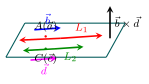
Figure 6.29Fig. 6.29 — Condition for coplanarity of two lines $L_1,L_2$ (directions $\vec b,\vec d$); $\vec b\times\vec d$ is perpendicular to the plane
Fig. 6.29 — Fig. 6.29 — Condition for coplanarity of two lines $L_1,L_2$ (directions $\vec b,\vec d$); $\vec b\times\vec d$ is perpendicular to the plane

Drawn by us to help you understand the concept clearly, and verified to make sure it's accurate. For exams, practice from your textbook's own diagram.

What this figure shows. Fig. 6.29 — Condition for coplanarity of two lines L1,L2L_1,L_2 (directions b⃗,d⃗\vec b,\vec d); b⃗×d⃗\vec b\times\vec d is perpendicular t …

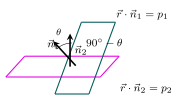
Figure 6.30Fig. 6.30 — Angle $\theta$ between two planes equals the angle between their normals $\vec n_1,\vec n_2$
Fig. 6.30 — Fig. 6.30 — Angle $\theta$ between two planes equals the angle between their normals $\vec n_1,\vec n_2$

Drawn by us to help you understand the concept clearly, and verified to make sure it's accurate. For exams, practice from your textbook's own diagram.

What this figure shows. Fig. 6.30 — Angle θ\theta between two planes equals the angle between their normals $\vec n_1,\ve …
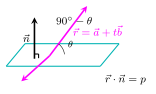
Figure 6.31Fig. 6.31 — Angle $\theta$ between a line $\vec r=\vec a+t\vec b$ and a plane $\vec r\cdot\vec n=p$ (complement $90^\circ-\theta$ with the normal $\vec n$)
Fig. 6.31 — Fig. 6.31 — Angle $\theta$ between a line $\vec r=\vec a+t\vec b$ and a plane $\vec r\cdot\vec n=p$ (complement $90^\circ-\theta$ with the normal $\vec n$)

Drawn by us to help you understand the concept clearly, and verified to make sure it's accurate. For exams, practice from your textbook's own diagram.

What this figure shows. Fig. 6.31 — Angle θ\theta between a line r⃗=a⃗+tb⃗\vec r=\vec a+t\vec b and a plane r⃗⋅n⃗=p\vec r\cdot\vec n=p (complement 90∘−θ90^\circ-\theta with the nor …

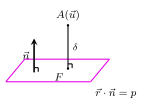
Figure 6.32Fig. 6.32 — Perpendicular distance $\delta$ from a point $A(\vec u)$ to a plane $\vec r\cdot\vec n=p$ (foot $F$, normal $\vec n$)
Fig. 6.32 — Fig. 6.32 — Perpendicular distance $\delta$ from a point $A(\vec u)$ to a plane $\vec r\cdot\vec n=p$ (foot $F$, normal $\vec n$)

Drawn by us to help you understand the concept clearly, and verified to make sure it's accurate. For exams, practice from your textbook's own diagram.

What this figure shows. Fig. 6.32 — Perpendicular distance δ\delta from a point A(u⃗)A(\vec u) to a plane r⃗⋅n⃗=p\vec r\cdot\vec n=p (foot FF, normal …

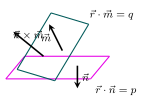
Figure 6.33Fig. 6.33 — Line of intersection of two planes $\vec r\cdot\vec n=p$ and $\vec r\cdot\vec m=q$, parallel to $\vec n\times\vec m$
Fig. 6.33 — Fig. 6.33 — Line of intersection of two planes $\vec r\cdot\vec n=p$ and $\vec r\cdot\vec m=q$, parallel to $\vec n\times\vec m$

Drawn by us to help you understand the concept clearly, and verified to make sure it's accurate. For exams, practice from your textbook's own diagram.

What this figure shows. Fig. 6.33 — Line of intersection of two planes r⃗⋅n⃗=p\vec r\cdot\vec n=p and r⃗⋅m⃗=q\vec r\cdot\vec m=q, parallel to $\vec n\tim …

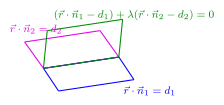
Figure 6.34Fig. 6.34 — A plane through the line of intersection of two given planes $\vec r\cdot\vec n_1=d_1$ and $\vec r\cdot\vec n_2=d_2$
Fig. 6.34 — Fig. 6.34 — A plane through the line of intersection of two given planes $\vec r\cdot\vec n_1=d_1$ and $\vec r\cdot\vec n_2=d_2$

Drawn by us to help you understand the concept clearly, and verified to make sure it's accurate. For exams, practice from your textbook's own diagram.

What this figure shows. Fig. 6.34 — A plane through the line of intersection of two given planes r⃗⋅n⃗1=d1\vec r\cdot\vec n_1=d_1 and $\vec r\cdot\vec …