Mathematics · Ch 2 — Complex Numbers
Algebraic Operations on Complex Numbers
Algebraic Operations on Complex Numbers
Three operations are defined on complex numbers .
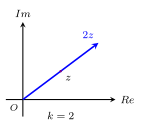
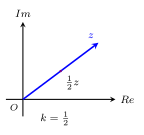
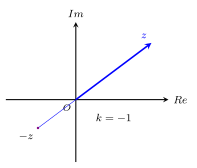
- Scalar multiplication. For real , — every part is scaled by . In particular , , and .
- Addition. For ,
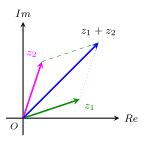
Since vectors are characterised by length and direction, and are unchanged under translation, when and the parallelogram law of addition applies: the sum corresponds to the point , obtained geometrically as the fourth vertex of the parallelogram with sides and .
- Subtraction. Defined via addition of the negative: . The vector representing can be drawn either as a position vector from the origin to , or — an equally valid, equivalent picture — as the vector joining the tip of to the tip of .
- Multiplication. Expanding and using :
Although the product of two complex numbers is again a complex number represented by a vector in the same plane, this product is neither the scalar product nor the vector (cross) product from ordinary vector algebra — it is its own, distinct operation. …
Drawn by us to help you understand the concept clearly, and verified to make sure it's accurate. For exams, practice from your textbook's own diagram.
What this figure shows. Scalar multiplication () stretches the vector …
Drawn by us to help you understand the concept clearly, and verified to make sure it's accurate. For exams, practice from your textbook's own diagram.
What this figure shows. Scalar multiplication () shrinks the vector $ …
Drawn by us to help you understand the concept clearly, and verified to make sure it's accurate. For exams, practice from your textbook's own diagram.
What this figure shows. Scalar multiplication () reverses the vector . …
Drawn by us to help you understand the concept clearly, and verified to make sure it's accurate. For exams, practice from your textbook's own diagram.
What this figure shows. Addition by the parallelogram law. …
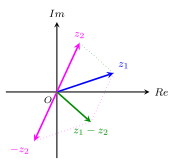
Drawn by us to help you understand the concept clearly, and verified to make sure it's accurate. For exams, practice from your textbook's own diagram.
What this figure shows. Subtraction as a position vector and as the join of the tip …
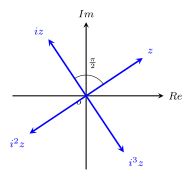
Drawn by us to help you understand the concept clearly, and verified to make sure it's accurate. For exams, practice from your textbook's own diagram.
What this figure shows. Multiplying by rotates a complex number by counter-clockwise ($z,iz,i^2z,i …