Mathematics · Ch 2 — Complex Numbers
Argand Plane
Argand Plane
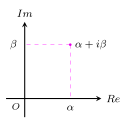
A complex number is uniquely determined by the ordered pair of real numbers : for instance and correspond to and respectively. This lets us associate a complex number with a point in a coordinate plane. Taking the -axis as the real axis and the -axis as the imaginary axis, this plane is called the complex plane or Argand plane, named after the Swiss mathematician Jean Argand (1768–1822).
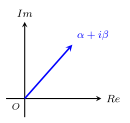
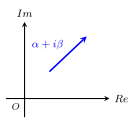
A complex number is represented not just by a point, but also by the position vector pointing from the origin to that point — the number, the point and the vector are all denoted by the same letter . (As with ordinary vectors, we identify vectors that differ only by a parallel displacement.) Geometrically, then, a complex number can be viewed either as a point in or as a vector in the Argand plane.
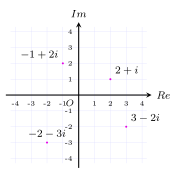
Example. Complex numbers such as , and can all be plotted as points (or drawn as arrows from the origin) in one Argand diagram. …
Drawn by us to help you understand the concept clearly, and verified to make sure it's accurate. For exams, practice from your textbook's own diagram.
What this figure shows. A complex number shown as a point in the Argand plan …
Drawn by us to help you understand the concept clearly, and verified to make sure it's accurate. For exams, practice from your textbook's own diagram.
What this figure shows. A complex number as a position vector from the origi …
Drawn by us to help you understand the concept clearly, and verified to make sure it's accurate. For exams, practice from your textbook's own diagram.
What this figure shows. A complex number as a free (translated) vector …
Drawn by us to help you understand the concept clearly, and verified to make sure it's accurate. For exams, practice from your textbook's own diagram.
What this figure shows. The complex numbers plotted as point …
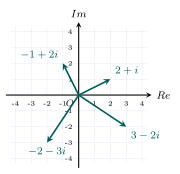
Drawn by us to help you understand the concept clearly, and verified to make sure it's accurate. For exams, practice from your textbook's own diagram.
What this figure shows. The complex numbers as position vector …