Mathematics · Ch 8 — Differentials and Partial Derivatives
Differentials
8.2.3
Differentials
Returning to the derivative dxdf=Δx→0limΔxf(x+Δx)−f(x)=f′(x) (Leibniz's notation for the differential coefficient): is it meaningful to treat dxdf as an actual quotient of two separate quantities df and dx — not merely a single symbol for a limit?
When f is linear, f(x)=mx+c, the answer is unambiguously yes: Δy=f(x+Δx)−f(x)=mΔx=f′(x)Δxexactly, for every x and every Δx (no limiting process needed, since a line's slope is the same everywhere). In this case
change in xchange in f=ΔxΔy=f′(x)=dxdf=dxdy,
so df/dx genuinely is the quotient of df=Δf=Δy and dx=Δx.
Definition 8.4 (Differential). For a general differentiable f:(a,b)→R, x∈(a,b), and Δx an increment given to x, the differential of f is
df=f′(x)Δx.(8)
Taking f(x)=x itself gives dx=f′(x)Δx=1⋅Δx=Δx — so the differential of the independent variable x is simply its change, dx=Δx, and (8) can be rewritten df=f′(x)dx: precisely the "quotient" reading of df/dx that motivated the whole discussion.
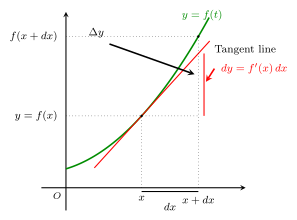
Geometric meaning. For y=f(x), let Δf=f(x+dx)−f(x) be the actual change in output along the curve, and let dy (or df) be the change along the tangent line instead: since the tangent line has slope f′(x), dy=f′(x)dx. From the picture, Δf≈dy=df=f′(x)dx — so f′(x) can be viewed (approximately) as the quotient of Δf and Δx, i.e. df/dx is legitimately interpreted as a quotient of df and dx, even though f itself is nonlinear.
Note
Unlike the derivative f′(x), which is a function of xalone, the differential df=f′(x)dx is a function of two independent, freely-chosen quantities: the point x and the increment dx. And Δf≈df — an approximation, not an identity, except when f is linear.
Differentials of standard functions (paired with their derivatives): f(x)=xn⇒df=nxn−1dx; f(x)=cos(x2+7)⇒df=−sin(x2+7)(2x)dx; f(x)=cot(x2)⇒df=−csc2(x2)(2x)dx; f(x)=sin−1x⇒df=1−x2dx; f(x)=tan−1x⇒df=1+x2dx; f(x)=e3x2−5x+7⇒df=e3x2−5x+7(6x−5)dx; f(x)=log(x2+1)⇒df=x2+12xdx — in every case, exactly the derivative multiplied by dx.
Properties of Differentials (for f,g differentiable, c a real constant):
Chain rule: if h=f∘g is defined, dh=f′(g(x))g′(x)dx.
If h(x)=ef(x), dh=ef(x)f′(x)dx.
If f(x)>0 and g(x)=log(f(x)), dg=f(x)f′(x)dx. …
Figure 8.4Fig. 8.4 Linear Approximation and Differential — the differential $dy=f'(x)\,dx$ measured along the tangent, compared with the true change $\Delta y$ of $y=f(x)$ over the increment $dx$
ⓘDrawn by us to help you understand the concept clearly, and verified to make sure it's accurate. For exams, practice from your textbook's own diagram.
What this figure shows. Fig. 8.4 Linear Approximation and Differential — the differential dy=f′(x)dx measured along the tangent, compared with the true change Δy of y=f(x) over …