Mathematics · Ch 11 — Probability Distributions
Probability Mass Function
Probability Mass Function
Definition 11.3 (Probability mass function). If is a discrete random variable taking the values , the function (also written ) defined by
is the probability mass function (pmf) of .
Theorem 11.1 (characterisation, without proof). is a pmf if and only if
(i) for every , and (ii) .
The set of values is also called the probability distribution of the discrete random variable. It can be presented in three equivalent ways: (a) as a table, (b) as a graph, or (c) as an algebraic expression.
Worked illustrations.
- Two fair coins, number of heads: — check: all and . …
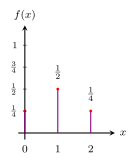
Drawn by us to help you understand the concept clearly, and verified to make sure it's accurate. For exams, practice from your textbook's own diagram.
What this figure shows. Probability mass function of for the number of heads when two coins are tossed: , , $f(2)=\frac{1}{4 …