Mathematics · Ch 11 — Probability Distributions
Probability Mass Function from Cumulative Distribution Function
Probability Mass Function from Cumulative Distribution Function
The reverse conversion is just as direct: given the cdf , the pmf is recovered as the jump size of at each of its points of discontinuity.
Working rule. If takes the values with cdf , then
(with the convention , i.e. the value of just before the first jump).
is non-decreasing and right-continuous, so its left-hand limit always exists, and the jump of at a point is . This jump is precisely — it is the probability mass sitting at . The set of discontinuities of a cdf is therefore at most countable, matching the countable support of the discrete random variable it belongs to. …
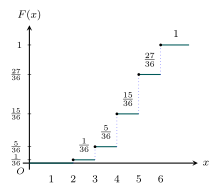
Drawn by us to help you understand the concept clearly, and verified to make sure it's accurate. For exams, practice from your textbook's own diagram.
What this figure shows. Cumulative distribution function (step function) for the total score in two throws: for , for , for , for , for , …
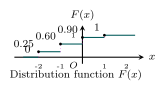
Drawn by us to help you understand the concept clearly, and verified to make sure it's accurate. For exams, practice from your textbook's own diagram.
What this figure shows. Distribution function F(x) of a discrete random variable drawn as a right-continuous step function, with jumps 0.25, 0.35, 0.30, 0.10 at x = -2, -1, 0, 1 giving cumulative heights 0. …