Biology · Ch 6 — Anatomy of Flowering Plants
Dicotyledonous Root
6.2.1
Dicotyledonous Root
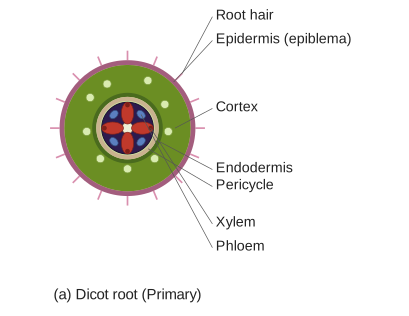
The internal structure of a dicotyledonous root can be understood from a transverse section of a young sunflower root. Passing from the outside towards the centre, its tissue organisation is as follows.
- The outermost layer is the epiblema. Many of the cells of the epiblema protrude in the form of unicellular root hairs.
- Next lies the cortex, which consists of several layers of thin-walled parenchyma cells with intercellular spaces between them.
- The innermost layer of the cortex is called the endodermis. It comprises a single layer of barrel-shaped cells without any intercellular spaces. The tangential as well as the radial walls of the endodermal cells carry a deposition of a water-impermeable, waxy material called suberin in the form of casparian strips.
- Just inside the endodermis lie a few layers of thick-walled parenchymatous cells that are referred to as the pericycle. The initiation of lateral roots and of the vascular cambium during secondary growth takes place in the cells of the pericycle.
- The pith is small or inconspicuous in the dicot root.
- The parenchymatous cells which lie between the xylem and the phloem are called conjunctive tissue. …
Figure 6.3a(a) Dicot root (Primary)
Drawn by us to help you understand the concept clearly, and verified to make sure it's accurate. For exams, practice from your textbook's own diagram.
This figure shows a transverse section of a dicot root (primary structure). The epidermis (epiblema) bears root hairs; beneath it lies the cortex, then the endodermis and pericycle surrounding a central stele with a small number of xylem and phloem patches …