Biology · Ch 6 — Anatomy of Flowering Plants
Monocotyledonous Root
Monocotyledonous Root
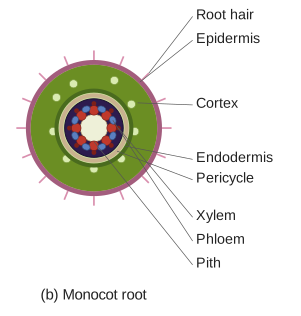
The anatomy of the monocotyledonous root is similar to that of the dicot root in many respects. A transverse section shows the same general set of tissues, arranged from the outside inwards:
- epidermis,
- cortex,
- endodermis,
- pericycle,
- vascular bundles, and
- pith.
The important differences from the dicot root are seen in the vascular tissue and the pith:
- As compared to the dicot root, which has only a few xylem bundles, the monocot root usually has more than six xylem bundles. Because there are many xylem strands, the condition is described as polyarch.
- The pith is large and well developed, unlike the small or inconspicuous pith of the dicot root. …
Drawn by us to help you understand the concept clearly, and verified to make sure it's accurate. For exams, practice from your textbook's own diagram.
This figure shows a transverse section of a monocot root. As in the dicot root, the epidermis, cortex, endodermis and pericycle surround the central stele, but here there are more numerous xylem and phloem patches (polyarch) arranged around a large, well-developed central pith -- the ma …