Biology · Ch 6 — Anatomy of Flowering Plants
Dorsiventral (Dicotyledonous) Leaf
6.2.5
Dorsiventral (Dicotyledonous) Leaf
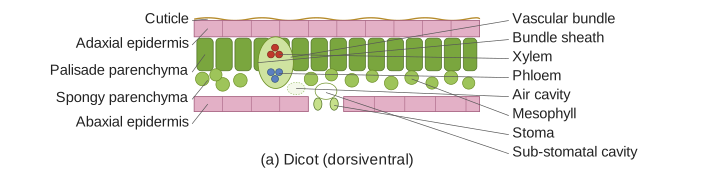
A vertical section through the lamina of a dorsiventral (dicotyledonous) leaf shows three main parts, namely the epidermis, the mesophyll and the vascular system.
- The epidermis covers both the upper surface, called the adaxial epidermis, and the lower surface, called the abaxial epidermis, of the leaf, and it bears a conspicuous cuticle. The abaxial (lower) epidermis generally bears more stomata than the adaxial (upper) epidermis, and the adaxial epidermis may even lack stomata altogether.
- The tissue lying between the upper and the lower epidermis is called the mesophyll. The mesophyll possesses chloroplasts and carries out photosynthesis, and it is made up of parenchyma. It consists of two types of cells:
- the palisade parenchyma, placed adaxially (towards the upper surface), which is made up of elongated cells arranged vertically and parallel to one another; and
- the spongy parenchyma, situated below the palisade cells and extending to the lower epidermis. Its cells are oval or round and loosely arranged, with numerous large spaces and air cavities between them. …
Figure 6.5a(a) Dicot (dorsiventral)
Drawn by us to help you understand the concept clearly, and verified to make sure it's accurate. For exams, practice from your textbook's own diagram.
This figure shows a transverse section of a dorsiventral (dicot) leaf. Below the cuticle and adaxial (upper) epidermis sits a compact layer of palisade parenchyma, then loosely packed spongy parenchyma above the abaxial (lower) epidermis, with vascular bundles (xylem facing up, phloem facing down inside a bundle sheath) embedded in the mesophyll -- distinctly different tiss …