Q.(i) Discuss the significance/applications of dipole moment.
You're viewing a preview — the full solution, concept, methods & PYQ mapping are locked.
Start your 14-day free trial to unlock the full solution →Dipole moment quantifies charge separation in molecules and reveals molecular geometry, polarity, and intermolecular forces. CO₂ is nonpolar (linear, bond moments cancel), while NF₃ and CHCl₃ are polar (pyramidal/tetrahedral with net moments).
Why Dipole Moment Matters
Dipole moment is the product of charge separation and distance, , measured in Debye (D). It arises whenever a molecule has an asymmetric distribution of electron density. The concept bridges structure and behavior: knowing whether a molecule is polar tells you how it will interact with electric fields, solvents, and other molecules.
The power of dipole moment lies in what it reveals without needing to "see" inside a molecule. A zero dipole moment in a polyatomic molecule immediately tells you the geometry is symmetric; a nonzero value confirms asymmetry. This makes it a diagnostic tool for structure determination and a predictor of physical properties.
(i) Significance and Applications of Dipole Moment
-
Determining molecular geometry and symmetry
When bond dipoles exist but the molecular dipole is zero, the geometry must be symmetric. For example, CO₂ has polar C=O bonds, but proves the molecule is linear. Conversely, water's bent shape gives a net dipole despite having two identical O–H bonds. Dipole moment is experimental evidence for VSEPR predictions.
-
Predicting solubility and miscibility
"Like dissolves like" rests on dipole moment. Polar solvents (water, ethanol) dissolve polar or ionic solutes because dipole–dipole or ion–dipole interactions stabilize the solution. Nonpolar molecules (hexane, benzene) dissolve nonpolar solutes through dispersion forces. The dipole moment of a solute immediately suggests which solvent class will work.
-
Understanding intermolecular forces
Dipole moment dictates the strength of dipole–dipole interactions. Molecules with larger experience stronger attractions, raising boiling and melting points. For instance, acetone ( D) boils higher than propane (nonpolar) of similar molar mass. Hydrogen bonding, the strongest dipole interaction, requires a dipole with H bonded to N, O, or F.
-
Assessing bond character and electronegativity
The dipole moment of a diatomic molecule measures the ionic character of the bond. Pure covalent bonds (H₂, Cl₂) have ; polar covalent bonds (HCl, HF) have intermediate values; ionic bonds approach the theoretical maximum. Comparing experimental with the value for a hypothetical 100% ionic bond gives the percentage ionic character.
-
Spectroscopy and molecular identification
Microwave spectroscopy detects rotational transitions, which require a permanent dipole moment. Only polar molecules absorb microwave radiation. Measuring the absorption spectrum yields bond lengths and angles. Infrared spectroscopy also depends on changing dipole moments during vibrations; symmetric stretches in CO₂ are IR-inactive because remains zero.
-
Reaction mechanisms and reactivity
Polar molecules have regions of partial positive and negative charge, creating reactive sites. Nucleophiles attack centers; electrophiles attack regions. The dipole moment of a carbonyl group (C=O) explains why the carbon is electrophilic in addition reactions. Dipole–dipole alignment also influences reaction rates in polar solvents.
A quick test: if you can draw a plane of symmetry that bisects all polar bonds, the molecule is nonpolar. If no such plane exists, expect a net dipole.
(ii) Diagrammatic Representation of Bond Moments and Resultant Dipole Moments
Carbon Dioxide (CO₂)
Structure: Linear, O=C=O, bond angle 180°.
Each C=O bond is polar, with oxygen more electronegative than carbon. The bond moment points from C (δ⁺) toward O (δ⁻).
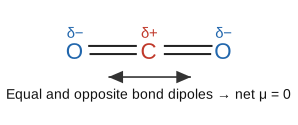
The two bond moments are equal in magnitude but opposite in direction. Vectorially:
Resultant dipole moment: D (nonpolar molecule).
The linear geometry ensures perfect cancellation. This is why CO₂ is a greenhouse gas (IR-active asymmetric stretches) yet nonpolar.
Nitrogen Trifluoride (NF₃)
Structure: Trigonal pyramidal (like ammonia), with a lone pair on nitrogen. Bond angles ≈ 102°.
Each N–F bond is polar, with fluorine far more electronegative than nitrogen. Bond moments point from N toward F. However, nitrogen also has a lone pair, which contributes electron density and a dipole moment pointing away from the bonded region (toward the lone pair). …
Unlock everything free for 14 days
- Full step-by-step solutions
- Concept-first explanations
- Methods, shortcuts & mistakes
- PYQ mapping + timed mock tests
Full access for 14 days. No credit card required.