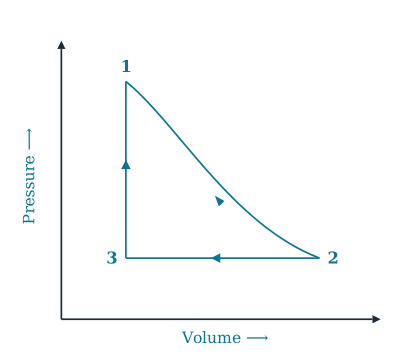
Q.A sample of 1.0 mol of a monoatomic ideal gas is taken through a cyclic process of expansion and compression as shown in Fig. 6.1. What will be the value of for the cycle as a whole?
You're viewing a preview — the full solution, concept, methods & PYQ mapping are locked.
Start your 14-day free trial to unlock the full solution →Enthalpy is a state function, so for any cyclic process that returns the system to its initial state, the change in enthalpy must be zero. for the complete cycle.
Why enthalpy change vanishes in a cycle
Enthalpy is a state function, meaning its value depends only on the current state of the system (pressure, temperature, composition) and not on the path taken to reach that state. This is the central insight.
When a system undergoes a cyclic process, it traces some path through different states but ultimately returns to exactly where it started: same pressure, same temperature, same volume, same everything. Because depends only on the state, and the initial and final states are identical, the change in enthalpy around the complete cycle must be:
This reasoning applies to any state function—internal energy , Gibbs free energy , entropy (for a reversible cycle), etc.
Step-by-step reasoning
-
Identify what changes during the cycle.
The gas expands and compresses through various intermediate states. At different points in the cycle, , , and all vary. The enthalpy at each intermediate point is different.
-
Recognize the defining property of a cycle.
The process is cyclic: the gas returns to its initial state. Every thermodynamic property that defines the state—pressure, volume, temperature, and therefore enthalpy—has the same value at the end as at the beginning.
-
Apply the state-function property.
For a state function, only the endpoints matter:
Since for a cycle, we have .
- Check independence from path details. …
Unlock everything free for 14 days
- Full step-by-step solutions
- Concept-first explanations
- Methods, shortcuts & mistakes
- PYQ mapping + timed mock tests
Full access for 14 days. No credit card required.