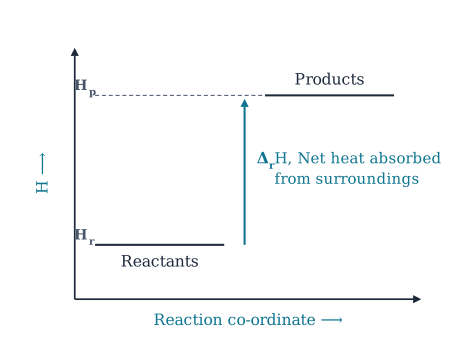
Q.Enthalpy diagram for a particular reaction is given in Fig. 6.3. Is it possible to decide spontaneity of a reaction from given diagram. Explain.
You're viewing a preview — the full solution, concept, methods & PYQ mapping are locked.
Start your 14-day free trial to unlock the full solution →No, it is not possible to decide the spontaneity of a reaction from the enthalpy change alone because spontaneity also depends on the change in entropy and the temperature.
When we talk about the spontaneity of a reaction, we are referring to its tendency to occur without continuous external intervention. While an enthalpy diagram provides crucial information about the energy change of a reaction, specifically the enthalpy change (), it is not the sole determinant of whether a reaction will proceed spontaneously. To fully understand spontaneity, we must also consider the concept of entropy.
The Role of Enthalpy and Entropy in Spontaneity
Chemical reactions tend to proceed in directions that lead to a lower energy state and a higher state of disorder.
- Enthalpy (): Represents the heat change at constant pressure. Reactions that release heat (exothermic, ) tend to be spontaneous because they move to a lower energy state.
- Entropy (): Represents the degree of disorder or randomness in a system. Reactions that increase disorder (increase in entropy, ) tend to be spontaneous because systems naturally move towards greater randomness.
The interplay between these two factors, enthalpy and entropy, along with temperature, dictates the spontaneity of a reaction.
-
Enthalpy Change () Alone is Insufficient
An enthalpy diagram shows the relative energy levels of reactants and products. If the products have lower enthalpy than the reactants, the reaction is exothermic (). If products have higher enthalpy, it's endothermic ().
- Many exothermic reactions are indeed spontaneous (e.g., combustion). This is because the system moves to a lower energy state.
- However, many endothermic reactions are also spontaneous. A classic example is the melting of ice above . This process absorbs heat from the surroundings (), yet it occurs spontaneously. This clearly demonstrates that a negative is not a prerequisite for spontaneity.
Watch outA common misconception is that all exothermic reactions are spontaneous and all endothermic reactions are non-spontaneous. This is incorrect because it ignores the role of entropy.
-
The Crucial Role of Entropy Change ()
Entropy is a measure of the dispersal of energy and matter in a system. A system with higher entropy has more ways to arrange its components.
- Reactions that lead to an increase in the number of gas molecules, a phase change from solid to liquid or liquid to gas, or an increase in the number of particles generally result in an increase in entropy ().
- For instance, when a solid dissolves in a liquid, even if the process is endothermic (like dissolving ammonium nitrate in water, which makes the solution cold), it can be spontaneous because the ions become more dispersed and disordered in the solution, leading to a significant increase in entropy.
-
Gibbs Free Energy (): The True Criterion for Spontaneity
The combined effect of enthalpy, entropy, and temperature on spontaneity is quantified by the Gibbs free energy change (). For a process occurring at constant temperature () and pressure, the change in Gibbs free energy is given by the Gibbs-Helmholtz equation:
For a reaction to be spontaneous under these conditions, must be negative ().
- If , the reaction is spontaneous.
- If , the reaction is non-spontaneous (the reverse reaction is spontaneous). …
Unlock everything free for 14 days
- Full step-by-step solutions
- Concept-first explanations
- Methods, shortcuts & mistakes
- PYQ mapping + timed mock tests
Full access for 14 days. No credit card required.