Mathematics · Ch 10 — Conic Sections
Ellipse
Ellipse
The Ellipse: A Definition
An ellipse is the set of all points in a plane for which the sum of the distances to two fixed points remains constant. Those two fixed points are called the foci (singular: focus) of the ellipse.
The constant sum of distances is always greater than the distance between the two foci. If it were equal, the set would be the line segment joining the foci; if smaller, no points would satisfy the condition.
The centre of the ellipse is the midpoint of the line segment joining the foci. The major axis is the line segment that passes through both foci and extends to the ellipse's farthest points. The minor axis is the line segment through the centre, perpendicular to the major axis. The endpoints of the major axis are called the vertices of the ellipse.
Standard Equation of an Ellipse
We place the ellipse in a coordinate system with its centre at the origin and its foci on the x-axis. Let the foci be at and , where . Let be any point on the ellipse. By definition, the sum of distances is constant. Call this constant (the reason for will become clear shortly).
So:
Using the distance formula:
Isolate one square root:
Square both sides:
Expand the squares:
Cancel from both sides:
Bring to the right:
Divide through by 4:
Rearrange:
Square again:
Expand:
Cancel from both sides:
Bring all terms to the left:
Factor:
Since (the constant sum exceeds the distance between foci), we have , so . Define . Then:
Divide through by :
This is the standard equation of an ellipse with centre at the origin and foci on the x-axis. Here is the length of the semi-major axis (half the major axis), and is the length of the semi-minor axis.
In the ellipse equation, is always the larger denominator. The foci lie on the axis corresponding to the larger denominator. For with , the foci are on the x-axis.
Key Elements of the Ellipse
For the ellipse (with ):
- Centre:
- Foci: , where
- Vertices: — these are the endpoints of the major axis
- Major axis: length , along the x-axis
- Minor axis: length , along the y-axis
- Endpoints of minor axis:
Ellipse with Foci on the y-axis
If the foci lie on the y-axis at , the same derivation (with roles of x and y swapped) gives:
Here , the major axis is along the y-axis of length , and the foci are at with .
The larger denominator always tells you which axis contains the foci and vertices. If is under , the major axis is horizontal; if under , the major axis is vertical.
Relationship Between a, b, and c
For any ellipse:
This follows directly from . The constant is the distance from the centre to each focus.
Eccentricity of an Ellipse
The eccentricity of an ellipse measures how "stretched" it is. It is defined as:
…
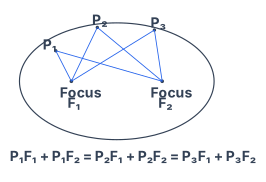
Drawn by us to help you understand the concept clearly, and verified to make sure it's accurate. For exams, practice from your textbook's own diagram.
The figure shows a single ellipse drawn on a plane. Two fixed points inside the ellipse are labelled and — these are the foci. Three distinct points, , , and , are marked on the upper arc of the ellipse. From each of these three points, two blue line segments are drawn: one to and one to . The caption states that the sum of the lengths of these two segments is the same for all three points.
The physical idea is the defining property of an ellipse: for any point on the curve, the sum of its distances to the two foci is constant. The figure makes this concrete by showing three different locations on the same ellipse and confirming that . The blue segments visually reinforce that each point is connected to both foci, and the equality of the sums is the geometric condition that picks out the ellipse from all other curves.
The constant sum is always greater than the distance between the foci. If it were equal to the distance between and , the set of points would collapse to the line segment joining the foci. If it were smaller, no points would satisfy the condition.
The textbook develops the standard equation of the ellipse from this definition. Let the distance between the foci be , and let the constant sum of distances be (with ). Place the foci at and on the -axis. For any point on the ellipse:
Substituting the distance formula:
After squaring and simplifying (a standard algebraic derivation), this becomes:
where . Here is the semi-major axis (half the length of the major axis, which passes through both foci), is the semi-minor axis (half the length of the minor axis, perpendicular to the major axis through the centre), and is the distance from the centre to each focus. The centre is the midpoint of , and the vertices are the endpoints of the major axis at . …
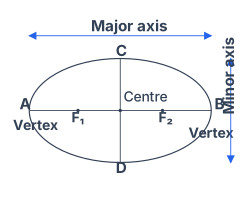
Drawn by us to help you understand the concept clearly, and verified to make sure it's accurate. For exams, practice from your textbook's own diagram.
Fig. 10.21 is the standard reference diagram for an ellipse with a horizontal major axis. The ellipse itself is drawn as a smooth, symmetric oval. Its centre is marked O, the midpoint of the two foci F₁ and F₂. The foci lie on the horizontal line through O, inside the ellipse, closer to the centre than the vertices.
The major axis is the longer horizontal line segment that passes through both foci and the centre. Its endpoints are the vertices, labelled A and B — these are the two farthest-apart points on the ellipse. A blue brace above the ellipse spans from A to B and is labelled "Major axis". The minor axis is the shorter vertical line segment through O, perpendicular to the major axis. Its endpoints are labelled C and D, and a blue brace to the right of the ellipse spans from C to D, labelled "Minor axis".
The physical idea is simple: for any point on the ellipse, the sum of its distances to F₁ and F₂ is constant. That constant is exactly the length of the major axis, . The foci are not at the centre — they are offset, and the distance from the centre to each focus is , where . The vertices are at if the centre is at the origin, and the foci at . The minor axis endpoints are at , where is related to and by .
Here is the semi-major axis (half the major axis length), the semi-minor axis, and the focal distance from the centre. The constant sum of distances from any point on the ellipse to the two foci is . The vertices are at , the foci at , and the centre at . The figure makes clear that the major axis is the longest diameter, the minor axis the shortest, and that the foci lie on the major axis symmetrically about the centre. …
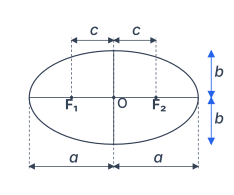
Drawn by us to help you understand the concept clearly, and verified to make sure it's accurate. For exams, practice from your textbook's own diagram.
The figure is a clean, labelled sketch of an ellipse centred at point . Two foci, and , sit symmetrically on the horizontal line through . The ellipse itself is the oval curve that wraps around both foci.
Three dashed lines with labels show the key lengths. The top dashed segment runs from the centre to one focus (or ); its length is labelled . The bottom dashed segment runs from to the rightmost point of the ellipse on the major axis; that point is a vertex, and the distance from centre to vertex is labelled . The right-hand dashed segment runs vertically from the centre up to the ellipse along the minor axis; its length is labelled . In the textbook, this vertical segment is drawn in blue.
The physical idea is simple: an ellipse is not a circle — it has two different axes. The longer one (the major axis) passes through the foci and has total length . The shorter one (the minor axis) is perpendicular to it and has total length . The foci are not at the centre; they are offset by distance on either side. The figure makes it clear that , , and are not independent — they are the three sides of a right triangle.
The three lengths , , and are related by the Pythagorean relation
where is the semi-major axis, is the semi-minor axis, and is the distance from the centre to each focus.
This relation is the foundation of every ellipse formula in the chapter. It comes directly from the definition: for any point on the ellipse, the sum of distances to the two foci is constant and equals . If you take the point at the top of the minor axis (where the blue segment ends), its distances to and are equal by symmetry, and the Pythagorean theorem in the right triangle formed by , , and that top point gives , which rearranges to the form above.
A common mistake is to think is the distance between the foci. It is not — is the distance from the centre to one focus. The distance between the foci is . …