Mathematics · Ch 10 — Conic Sections
Parabola
Parabola
The Definition of a Parabola
A parabola is the set of all points in a plane that are equidistant from a fixed line and a fixed point (not on the line) in the plane. The fixed line is called the directrix, and the fixed point is called the focus.
The word "parabola" comes from Greek: para meaning "for" and bola meaning "throwing" — it describes the shape traced when you throw a ball in the air.
If the fixed point lies on the fixed line, then the set of points equidistant from them is simply the straight line through the fixed point and perpendicular to the fixed line. This is called the degenerate case of the parabola — it is not a true parabola.
Key Terms
A line through the focus and perpendicular to the directrix is called the axis of the parabola. The point where the parabola intersects its axis is called the vertex of the parabola.
The vertex is the midpoint of the perpendicular segment from the focus to the directrix. It is the point on the parabola closest to both the focus and the directrix.
Standard Equation of a Parabola
We now derive the simplest equation of a parabola. Place the focus at where , and let the directrix be the vertical line . The axis is the x-axis, and the vertex is at the origin .
Let be any point on the parabola. By definition, the distance from to the focus equals the perpendicular distance from to the directrix.
Distance from to :
Distance from to the directrix :
Setting them equal:
Square both sides:
Expand:
Cancel and :
This is the standard equation of a parabola with vertex at the origin, focus at , and directrix .
Other Standard Forms
By symmetry, we get three other standard forms depending on the orientation:
- Right-opening: — focus , directrix , axis
- Left-opening: — focus , directrix , axis
- Upward-opening: — focus , directrix , axis
- Downward-opening: — focus , directrix , axis
The sign of the coefficient tells you the direction: positive means the parabola opens toward the positive axis direction; negative means it opens toward the negative axis direction.
Latus Rectum
The latus rectum of a parabola is a line segment through the focus, perpendicular to the axis, with its endpoints on the parabola.
For , the focus is at . The line through the focus perpendicular to the axis (the x-axis) is the vertical line . Substituting into the equation:
So . The endpoints are and .
The length of the latus rectum is the distance between these endpoints: .
The length of the latus rectum is for all four standard forms. It is a key parameter that determines the "width" of the parabola.
Summary Table of Standard Parabolas
| Equation | Focus | Directrix | Axis | Vertex | Length of Latus Rectum |
|---|---|---|---|---|---|
Properties of Parabola (as listed in the textbook)
The textbook lists several properties. Here they are with full derivations.
›Proof
Property I: The parabola is symmetric about its axis.
For , the axis is the x-axis. If lies on the parabola, then . The point also satisfies the same equation because . So the parabola is symmetric about the x-axis. Similarly, for , symmetry about the y-axis holds.
›Proof
Property II: The vertex is the point on the parabola closest to the focus and the directrix. …
A parabola is the set of all points in a plane that are equidistant from a fixed line (called the directrix) and a fixed point (called the focus) that does not lie on that line.
If the focus lies on the directrix, the set of points equidistant from both is simply the straight line through the focus that is perpendicular to the directrix. This special case is called a degenerate parabola.
The axis of the parabola is the line through the focus perpendicular to the directrix. The vertex is the point where the parabola intersects its axis.
The word "parabola" comes from Greek — para meaning "for" and bola meaning "throwing" — describing the path of a ball thrown in the air.
Intuition: Imagine a point moving so that it stays exactly as far from a fixed point (focus) as it does from a fixed line (directrix). The path it traces is a parabola — a symmetric, U-shaped curve. …
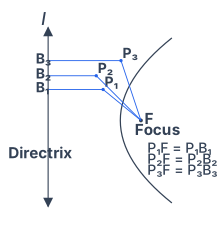
Drawn by us to help you understand the concept clearly, and verified to make sure it's accurate. For exams, practice from your textbook's own diagram.
The figure shows a vertical line labelled l (the directrix) on the left side of the diagram, and a point F (the focus) to the right of that line. The curve drawn is a parabola that opens to the right, with its vertex somewhere between the directrix and the focus. Three points — P₁, P₂, P₃ — are marked on the parabola at different positions along the curve.
From each point P, two segments are drawn. One segment goes horizontally leftwards to meet the directrix at a point labelled B (with the same subscript: B₁, B₂, B₃). The other segment goes directly to the focus F. The caption tells you the key relationship: for each point, the length PF equals the length PB. That is, the distance from any point on the parabola to the focus is exactly equal to the perpendicular distance from that point to the directrix.
The horizontal segment PB is drawn perpendicular to the directrix because the directrix is vertical — so the shortest distance from P to the line l is indeed a horizontal line. This is the geometric definition in action: every point on the parabola satisfies , where B is the foot of the perpendicular from P onto the directrix.
The parabola is defined as the set of all points in a plane that are equidistant from a fixed point (focus) and a fixed line (directrix). This is the definition that generates the standard equations.
From this figure, the textbook develops the standard equation of a parabola. If we place the focus at and the directrix as the vertical line , then for any point on the parabola:
- Distance to focus:
- Perpendicular distance to directrix:
Setting these equal gives:
Squaring both sides and simplifying yields the standard form:
Here is the distance from the vertex to the focus (and also from the vertex to the directrix). The vertex is at the origin , the axis is the x-axis, and the parabola opens to the right. The focus is at and the directrix is .
The three points P₁, P₂, P₃ in the figure illustrate that this equality holds at any location along the curve — near the vertex, farther up, or farther down. The horizontal segments to the directrix make it visually clear that the distance being compared is the perpendicular distance, not some slanted measurement. …
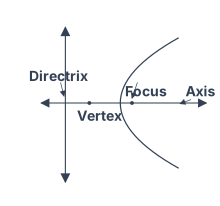
Drawn by us to help you understand the concept clearly, and verified to make sure it's accurate. For exams, practice from your textbook's own diagram.
Fig. 10.14 is the standard reference diagram for a parabola. It shows a single curve that opens to the right, drawn on a blank coordinate plane. The curve is symmetric about a horizontal line — that line is the axis of the parabola, and it runs left-to-right through the centre of the shape. Perpendicular to this axis, drawn as a vertical dashed line on the left side of the figure, is the directrix. The focus is marked as a single point on the axis, to the right of the directrix. Exactly halfway between the focus and the directrix, on the axis, is the vertex — the point where the parabola turns. The vertex is the leftmost point of the curve.
The physical idea the figure teaches is the definition of a parabola: every point on the curve is exactly the same distance from the focus (a fixed point) as it is from the directrix (a fixed line). If you pick any point on the curve, draw a straight line from it to the focus, and drop a perpendicular from it to the directrix, those two distances are equal. The axis is the line through the focus that is perpendicular to the directrix; the vertex is the point on the parabola that lies on this axis, and it is the point closest to both the focus and the directrix.
The vertex is the midpoint of the perpendicular segment from the focus to the directrix. This geometric fact is the foundation for the standard equation.
From this figure, the textbook derives the standard equation of a parabola with vertex at the origin and axis along the -axis. Let the focus be at and the directrix be the vertical line , where . For any point on the parabola, the distance to the focus is , and the distance to the directrix is . Setting them equal gives:
Squaring both sides and simplifying yields the standard form:
Here, is the distance from the vertex to the focus (and also from the vertex to the directrix). The axis is the -axis, the vertex is at , the focus is at , and the directrix is the line . The parabola opens to the right because . If , the parabola would open to the left, with the focus at and directrix .
Do not confuse with the coefficient in . In the parabola , the constant controls the "width" — a larger makes the parabola wider. The vertex is always at the origin in this standard orientation. …