Exercises · 3.9
Q.A cyclist starts from the centre of a circular park of radius . She first rides straight out along a radius to the edge of the park (with at the centre and the radius pointing horizontally to the right). She then rides a quarter of the way around the circumference from to a point on the edge, where is positioned so that the radius is perpendicular to (i.e. lies directly above ). Finally she returns straight from back to the centre along the radius , as shown below.
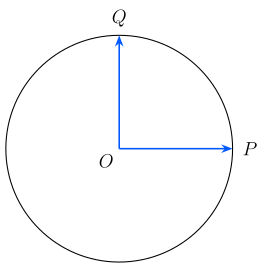
If the whole round trip takes , what is the
(a) net displacement,
(b) average velocity, and
(c) average speed of the cyclist?
Punjab PsebTextbookSubjective· 3mImportance★★★★★est
26% · 18/68 Questions
You're viewing a preview — the full solution, concept, methods & PYQ mapping are locked.
Start your 14-day free trial to unlock the full solution →The cyclist begins and finishes at the centre , so her net displacement is zero and therefore her average velocity is also zero. Her average speed, however, is not zero: it is the total distance travelled divided by the trip time, giving about .
Concept
Displacement is the straight-line vector from the starting point to the finishing point. Average velocity (a vector), while average speed (a scalar). When start and end coincide, displacement is zero even though the distance travelled is not.
The three legs of the trip
- (radius, out to the edge) .
- Arc (a quarter of the circumference) .
- (radius, back to the centre) .
(a) Net displacement
The cyclist starts at and returns to , so the initial and final positions are the same:
(b) Average velocity
(c) Average speed …
Unlock everything free for 14 days
- Full step-by-step solutions
- Concept-first explanations
- Methods, shortcuts & mistakes
- PYQ mapping + timed mock tests
Full access for 14 days. No credit card required.