Q.A ball is thrown vertically upwards with a velocity of from the top of a multistorey building. The height of the point from where the ball is thrown is from the ground.
You're viewing a preview — the full solution, concept, methods & PYQ mapping are locked.
Start your 14-day free trial to unlock the full solution →This is a two-part projectile motion problem under constant gravity. For part (a), the ball rises until its velocity becomes zero — using gives a maximum height of above the throw point. For part (b), the total time to hit the ground is found by solving the quadratic displacement equation from the throw point to the ground (), yielding .
The key idea here is that the ball moves under constant acceleration due to gravity ( downward). We choose a sign convention: upward is positive, downward is negative. So acceleration is .
We treat the motion in two natural phases: the upward journey until the ball stops, and then the downward journey from that highest point to the ground. But we can also solve the whole motion in one go using the equations of motion — that's what we'll do for part (b).
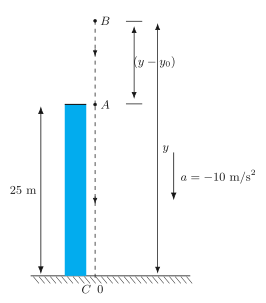
Figure 2.6 shows this exact setup: the building drawn as a solid bar 25 m tall, with the throw point at the top labelled A and a dashed curved path rising to the highest point B, where marks the extra height gained above A. The origin is at the ground, so the ball's full height above the ground is the longer bracket ; point C marks the foot of the building directly below A. The downward arrow labelled is a reminder that gravity acts throughout, including while the ball is still rising.
1. Part (a): How high will the ball rise?
At the highest point, the ball's velocity becomes zero for an instant. We know:
- Initial velocity
- Final velocity
- Acceleration
- Displacement (height above the throw point)
Use the equation :
So the ball rises 20 metres above the point of throw.
A common mistake is to forget that the building is 25 m tall. The question asks "how high will the ball rise?" — this means the height above the throw point, not above the ground. The height above ground would be , but that's not what part (a) asks.
2. Part (b): How long before the ball hits the ground? …
Unlock everything free for 14 days
- Full step-by-step solutions
- Concept-first explanations
- Methods, shortcuts & mistakes
- PYQ mapping + timed mock tests
Full access for 14 days. No credit card required.