Physics · Ch 6 — System of Particles and Rotational Motion
Angular Velocity and its Relation with Linear Velocity
Angular Velocity and its Relation with Linear Velocity
Opening the Idea: What is Angular Velocity?
When a rigid body rotates about a fixed axis, different points on the body move with different linear speeds. A point farther from the axis covers a larger circumference in the same time, so its linear speed is greater. Yet, every point on the body sweeps out the same angle in the same time. This common rate of angular displacement is the angular velocity of the body.
Angular velocity is a vector quantity. Its magnitude, denoted by (omega), is the rate of change of angular displacement :
The direction of the angular velocity vector is along the axis of rotation, given by the right-hand rule: if you curl the fingers of your right hand in the direction of rotation, your thumb points along the axis in the direction of .
For a rigid body rotating about a fixed axis, every particle of the body has the same angular velocity . This is what makes angular velocity a property of the body as a whole, not of individual particles.
Relating Linear Velocity to Angular Velocity
Consider a rigid body rotating about a fixed axis with angular velocity . Take any particle of the body located at a perpendicular distance from the axis. Let its position vector with respect to a point on the axis be .
As the body rotates, this particle moves in a circle of radius (the perpendicular distance from the axis). Its linear velocity is always tangential to this circle.
The fundamental relation is:
This vector cross product gives both the magnitude and direction of the linear velocity.
Magnitude:
, where is the angle between and . Since is along the axis and is perpendicular to the axis (for the component that matters), and . Therefore:
Here is the perpendicular distance of the particle from the axis of rotation.
Direction:
The cross product gives a vector perpendicular to both and . This direction is exactly the tangent to the circular path of the particle, consistent with the right-hand rule.
A common mistake is to use the full position vector from an arbitrary origin. The in is always the perpendicular distance from the axis of rotation, not the distance from some arbitrary point.
Properties of the Relation
The textbook lists three important properties that follow from this vector relation. Each is derived below.
›Proof
Property (I): For a particle on the axis of rotation, .
If a particle lies exactly on the axis of rotation, its perpendicular distance from the axis is . Substituting into gives . Physically, points on the axis do not move — they are stationary as the body rotates around them. This is why we speak of a "fixed axis."
›Proof
Property (II): For a given , is proportional to . …
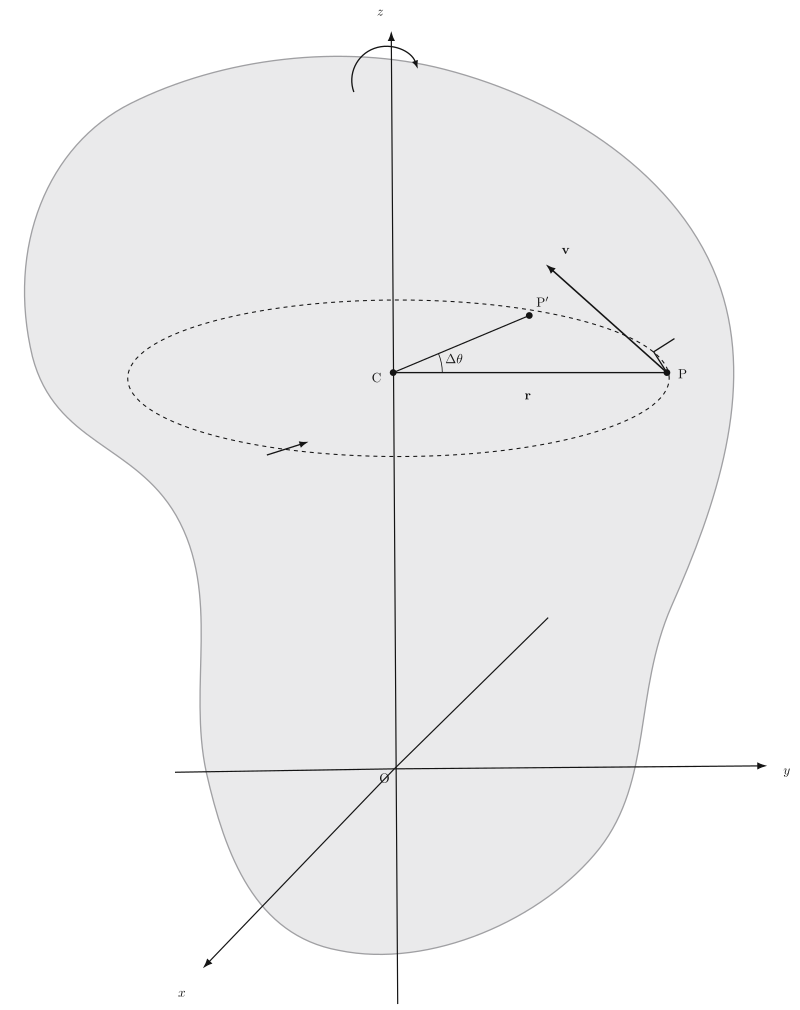
Drawn by us to help you understand the concept clearly, and verified to make sure it's accurate. For exams, practice from your textbook's own diagram.
The figure shows a rigid body rotating about a fixed vertical axis — the -axis. The origin is placed somewhere on that axis. The -axis points to the right, and the -axis points down and to the left (a standard right-handed coordinate system). A dashed horizontal circle is drawn with its centre on the -axis; this circle lies in a plane perpendicular to the axis of rotation.
A particle of the rigid body is shown on that circle. The radius of the circle — the perpendicular distance from to the axis — is labelled . A nearby position is also marked, separated from by a small angular displacement . The velocity vector of the particle is drawn tangent to the circle at , perpendicular to the radius .
The physical idea is straightforward: when a rigid body rotates about a fixed axis, every particle moves in a circle whose centre lies on the axis. The particle's linear velocity is not the same for all particles — it depends on how far the particle is from the axis. But every particle shares the same angular velocity , which points along the axis of rotation (upward for counterclockwise rotation, by the right-hand rule).
The key relation the textbook develops from this figure is the connection between angular velocity and linear velocity:
Here is the position vector of the particle taken from any point on the axis (often from or from ). The magnitude of this cross product gives , where is the angle between and . Since is along the axis and is perpendicular to the axis for a particle on the circle, and , so:
The direction of is given by the right-hand rule: curl the fingers of your right hand in the direction of rotation; your thumb points along . For a particle, is tangent to the circle, perpendicular to both and .
A common mistake is to think that in is the distance from the axis. It is not — it is the full position vector from a point on the axis to the particle. The perpendicular distance is what actually appears in the magnitude formula . For the particle in the figure, because the particle lies in a plane perpendicular to the axis. …
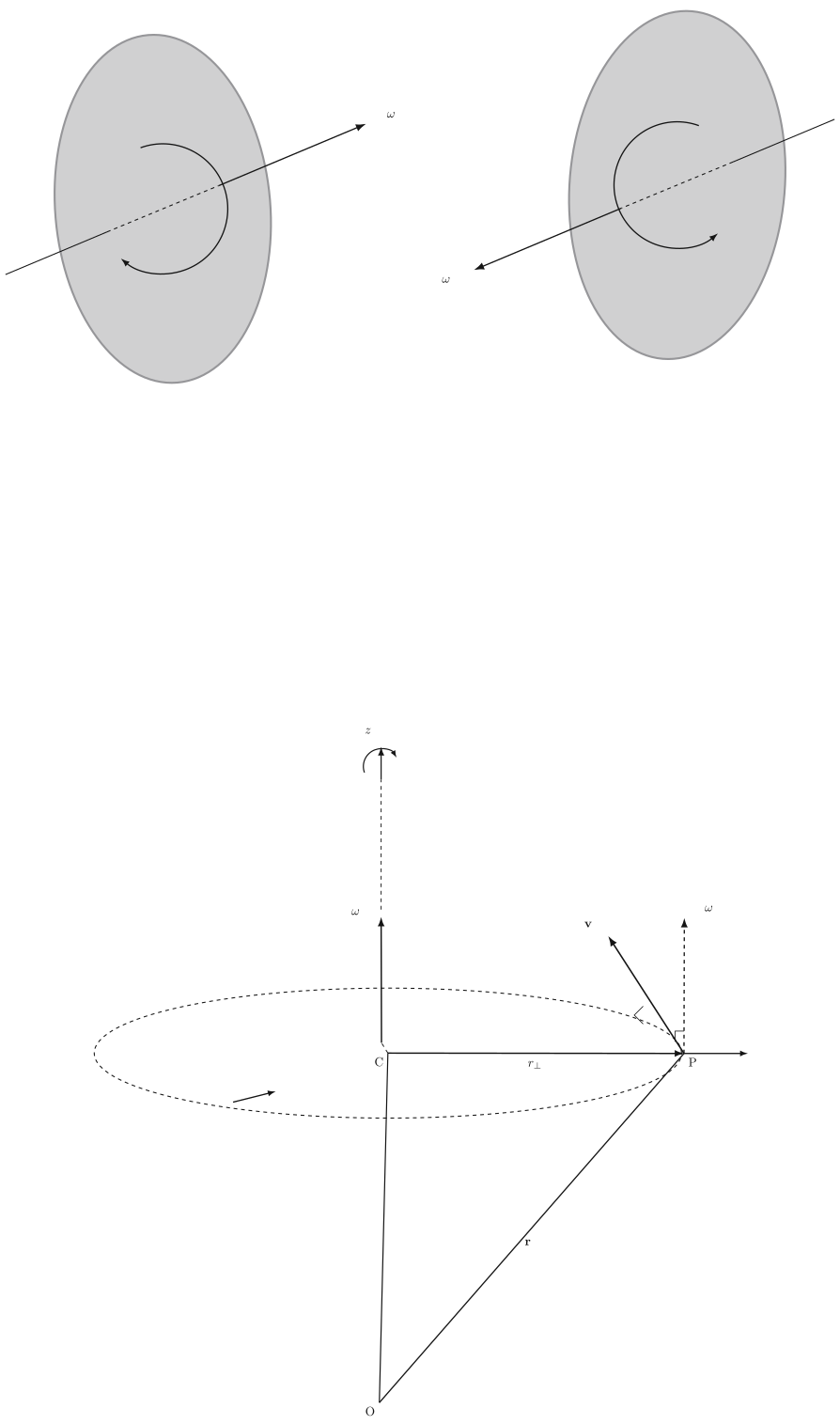
Drawn by us to help you understand the concept clearly, and verified to make sure it's accurate. For exams, practice from your textbook's own diagram.
The figure has two panels, (a) and (b), and they serve two different but connected purposes.
Panel (a) establishes the direction of angular velocity . It shows two shaded disks, each rotating in opposite senses. For each disk, the vector is drawn along the axis of rotation. The key idea is the right-handed screw rule: if you curl the fingers of your right hand in the direction of rotation, your thumb points along . So one disk rotates clockwise when viewed from above, and its points downward; the other rotates anticlockwise, and its points upward. The figure makes it clear that is not a "spin" that lives on the rim — it is an axial vector that lies along the axis of rotation, with its sense determined by the rotation sense.
Panel (b) moves from the axis to a single point on the rotating body. It shows a -axis with drawn along it. A point is located on the body. The centre is the foot of the perpendicular from to the axis — so lies on the axis, and the line is perpendicular to the axis. The distance is labelled (the perpendicular distance from the axis to the point). The vector from the origin (some fixed point on the axis) to is . A dashed circle is drawn in the plane perpendicular to the axis, centred at and passing through — this is the circular path that follows as the body rotates. Finally, the velocity is shown as a vector tangent to this circle at .
The physical idea is that every point in a rigid body rotating with angular velocity moves in a circle around the axis. The linear velocity of a point is not simply ; it depends on the perpendicular distance from the axis, not on the distance from the origin.
Here is the angular velocity vector (direction along the axis, magnitude ), is the position vector of the point from any origin on the axis, and is the instantaneous linear velocity of that point. The cross product ensures three things: (1) is perpendicular to both and ; (2) its magnitude is , where is the angle between and . But since is along the axis and makes an angle with it, is exactly the perpendicular distance from the axis to the point. So , which matches the geometry of the dashed circle in panel (b). (3) The direction of is tangent to the circle, as shown. …