Physics · Ch 6 — System of Particles and Rotational Motion
Equilibrium of a Rigid Body
Equilibrium of a Rigid Body
Equilibrium of a Rigid Body
When we shift from studying general systems of particles to rigid bodies, the effect of external forces becomes richer. Forces do more than just change the translational state — they also change the rotational state. A rigid body's total linear momentum changes according to the net force, and its total angular momentum changes according to the net torque.
A rigid body is in mechanical equilibrium when both its linear momentum and angular momentum are constant in time. This means the body has neither linear acceleration nor angular acceleration. Two conditions must hold simultaneously.
Condition for Translational Equilibrium
The vector sum of all external forces acting on the rigid body must be zero:
When this holds, the total linear momentum of the body does not change with time. This is the condition for translational equilibrium.
Condition for Rotational Equilibrium
The vector sum of all external torques acting on the rigid body must be zero:
When this holds, the total angular momentum of the body does not change with time. This is the condition for rotational equilibrium.
A common mistake is to think that if the net force is zero, the body is automatically in equilibrium. This is false — a couple produces rotation without translation, so the body can have angular acceleration even when the net force is zero.
Independence of Rotational Equilibrium from Origin
A natural question arises: does the rotational equilibrium condition (6.30b) remain valid if we shift the origin about which torques are calculated? The answer is yes — provided the translational equilibrium condition (6.30a) holds. If the net force on the body is zero, then the rotational equilibrium condition is independent of the location of the origin.
Example 6.7 in the textbook proves this for the special case of a couple (two forces). The generalisation to forces follows the same logic.
Scalar Equations for Equilibrium
Both equations (6.30a) and (6.30b) are vector equations. Each is equivalent to three scalar equations.
For translational equilibrium:
where , , are the , , components of the force .
For rotational equilibrium:
where , , are the , , components of the torque .
Together, equations (6.31a) and (6.31b) give six independent conditions that must be satisfied for the mechanical equilibrium of a rigid body.
Coplanar Forces: A Simpler Case
When all forces acting on the body lie in a single plane, the problem simplifies considerably. Only three conditions are needed:
- The sum of the components of the forces along any two perpendicular axes in the plane must be zero (two conditions for translational equilibrium).
- The sum of the components of the torques along any axis perpendicular to the plane of the forces must be zero (one condition for rotational equilibrium).
For coplanar force problems, choose your axes wisely. Often one axis can be aligned along a direction where many forces have zero components, reducing the algebra.
Comparison with Equilibrium of a Particle
For a particle, rotational motion does not apply. Only the condition for translational equilibrium (equation 6.30a) matters. Since all forces act on a single particle, they must be concurrent — they all pass through the same point. Equilibrium under concurrent forces was covered in earlier chapters.
Partial Equilibrium
A body can be in partial equilibrium — it may satisfy one condition but not the other.
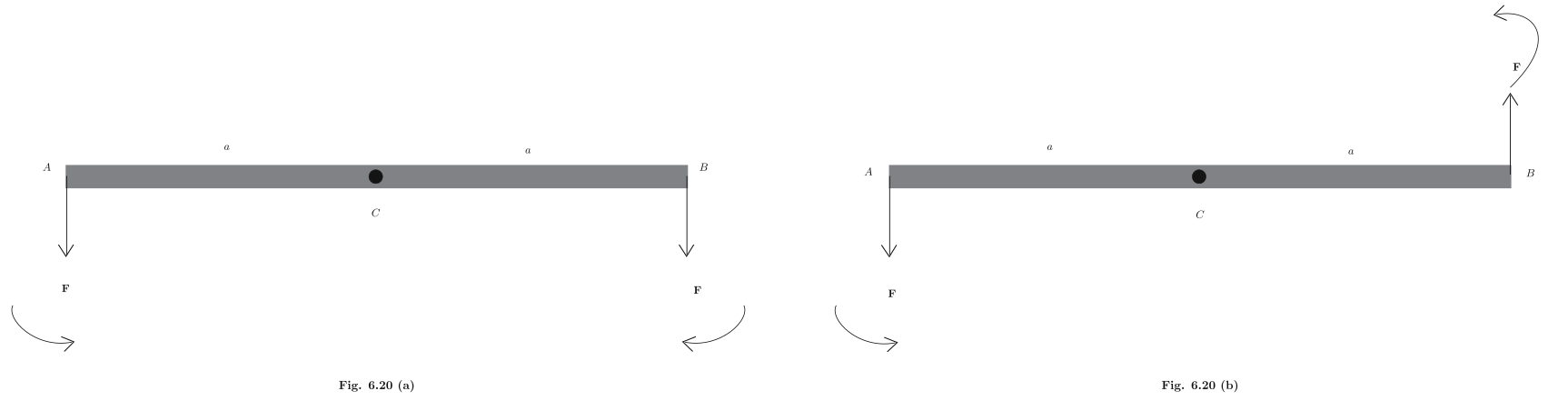
Consider a light rod AB of negligible mass, with two equal forces applied perpendicular to the rod at its ends.
Case 1: Both forces in the same direction [Fig. 6.20(a)]
Let C be the midpoint of AB, with CA = CB = . The moments of the forces at A and B are both equal in magnitude () but opposite in sense. The net moment on the rod is zero, so the rod is in rotational equilibrium. However, the net force is (not zero), so the rod is not in translational equilibrium.
Case 2: Forces in opposite directions [Fig. 6.20(b)]
Now the force at B is reversed. The two forces have equal magnitude but act in opposite directions. The moments of both forces are equal and act in the same sense — both cause anticlockwise rotation. The net force on the body is zero, so the body is in translational equilibrium. But the net torque is not zero, so the body is not in rotational equilibrium. The rod undergoes pure rotation — rotation without translation.
The Couple
A pair of forces of equal magnitude acting in opposite directions with different lines of action is called a couple or a torque. A couple produces rotation without translation.
Familiar examples include:
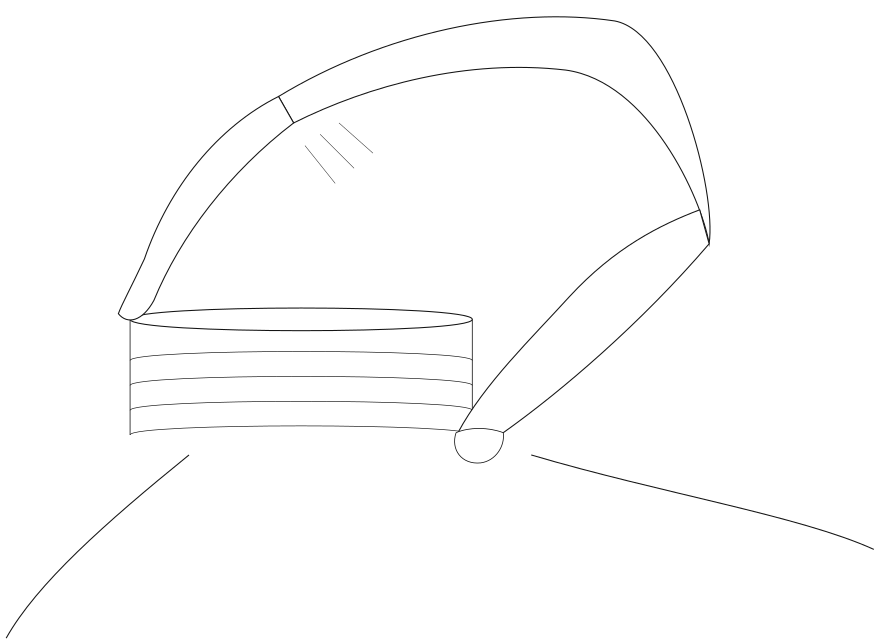
- Opening a bottle lid by turning it — your fingers apply a couple to the lid [Fig. 6.21(a)].
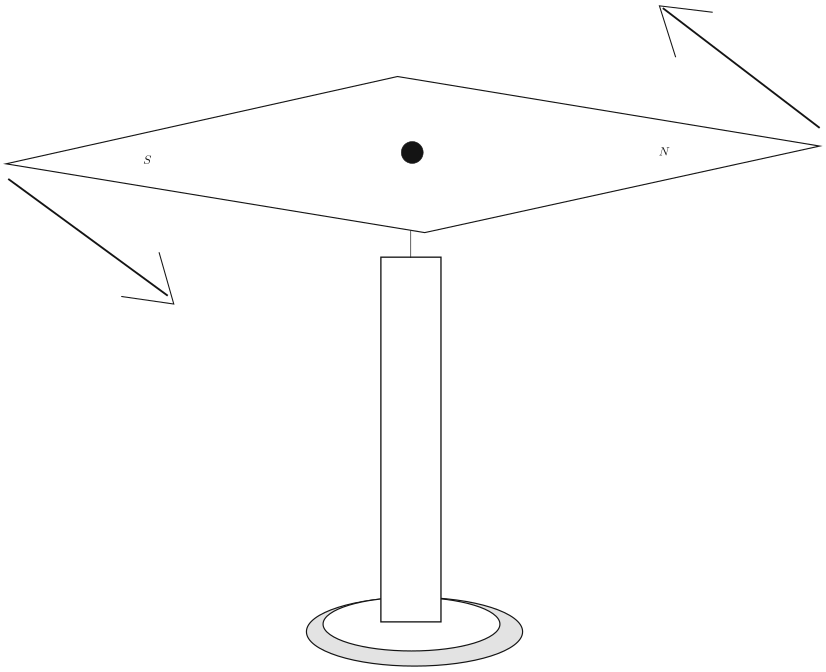
- A compass needle in the Earth's magnetic field [Fig. 6.21(b)]. The Earth's field exerts equal forces on the north and south poles — the force on the north pole is toward the north, and the force on the south pole is toward the south. Except when the needle points north-south, these two forces do not have the same line of action, forming a couple.
A couple is the purest form of torque — it produces angular acceleration without any linear acceleration. The moment of a couple is the same regardless of which point you take as the origin.
Proof: Moment of a Couple is Independent of Origin …
Drawn by us to help you understand the concept clearly, and verified to make sure it's accurate. For exams, practice from your textbook's own diagram.
Figure 6.20 is a two-panel sketch of a single light rod AB with its midpoint labelled C. The rod is drawn as a straight horizontal line, and the distance from C to each end is the same — call it . The figure never shows any axes or curves; it is a pure force diagram.
In panel (a), two equal parallel forces act downward at A and B. Both forces have the same magnitude and the same direction (downwards). Because the rod is light (its own weight is negligible), the only forces on it are these two applied forces. The rod is in equilibrium: the net force is downward, but the rod is not free to translate — it is held in place by some support not shown. More importantly, the net torque about C is zero: the force at A tends to rotate the rod clockwise, the force at B tends to rotate it anticlockwise, and because the lever arms are equal ( on each side), the two torques cancel exactly. This panel illustrates a pure translational force system — two equal, parallel, same‑direction forces produce no net torque about the centre, only a net force.
Panel (b) reverses the direction of the force at B: now the force at A is downward and the force at B is upward, both still of magnitude . The net force is now , so there is no tendency for translation. But the torque about C is no longer zero. The downward force at A produces a clockwise torque of magnitude , and the upward force at B also produces a clockwise torque of magnitude (because an upward force on the right side also tries to turn the rod clockwise). The two torques add, giving a net torque clockwise. This arrangement is a couple — two equal, opposite, parallel forces separated by a perpendicular distance. A couple produces pure rotation with no net force.
The key result the textbook develops from this figure is the torque of a couple. For two forces of magnitude acting in opposite directions, separated by a perpendicular distance , the magnitude of the torque is
where is the distance between the lines of action of the two forces. In panel (b), , so .
The symbols are:
- — magnitude of each force (in newtons),
- — distance from the midpoint C to either end of the rod (in metres),
- — perpendicular separation between the two forces (the full length of the rod),
- — magnitude of the torque produced by the couple (in newton‑metres). …
Drawn by us to help you understand the concept clearly, and verified to make sure it's accurate. For exams, practice from your textbook's own diagram.
This figure shows two fingers turning the lid of a jar. The thumb presses down on one side of the fluted lid rim while the index finger presses down on the opposite side, with the palm and wrist arching over the top connecting the two. Because the two fingers push in opposite senses around the lid's centre, together they apply a couple to the lid -- a pair of equal, oppositely-directed forces acting along different (non-collinear) lines of action -- and that couple is what makes the lid spin in place without the jar itself moving. This is the same everyday action the text refers to just before the compass-needle example: whenever you unscrew a bottle cap or a jar lid, your finger …
Drawn by us to help you understand the concept clearly, and verified to make sure it's accurate. For exams, practice from your textbook's own diagram.
The figure shows a compass needle shaped like a rhombus, with its north pole (N) and south pole (S) at the two pointed ends. The needle is mounted on a pivot at its centre, free to rotate. Two arrows at the tips represent the forces acting on each pole: a force on the north pole and an equal force on the south pole. These forces are drawn parallel to each other, pointing in opposite directions, and they lie in the plane of the needle. The pivot is at the centre of the rhombus, so the two forces are separated by a perpendicular distance — the length of the needle between the poles.
The physical idea is that the Earth's magnetic field is nearly uniform over the size of a small compass needle. In a uniform field, the north pole experiences a force in the direction of the field, and the south pole experiences an equal force opposite to the field. Because these forces are equal, opposite, and not collinear (they act at different points), they form a couple — a pair of forces that produces pure rotation with no net translation. The needle rotates until its north pole points toward magnetic north, aligning with the field. This is the same principle that makes a current-carrying loop rotate in a magnetic field.
The key formula developed from this figure is the torque on a magnetic dipole in a uniform magnetic field. For a compass needle of magnetic moment (a vector from south to north, of magnitude , where is the pole strength and is the separation between poles), placed in a uniform magnetic field , the torque is:
The magnitude is , where is the angle between and . The direction of the torque is given by the right-hand rule — it always tries to rotate the needle so that aligns with (i.e., ). This is the rotational analogue of the force on an electric dipole in a uniform electric field, and it is the foundation for understanding the equilibrium of a rigid body under a couple: the net force is zero, but the net torque is not, so the body rotates about its centre of mass.
Do not confuse the magnetic moment with the mass. In this context, is a vector property of the magnet, not a mass. The pole strength is measured in ampere-metres (A·m), and the magnetic field in tesla (T). The torque has units of newton-metre (N·m). …