Physics · Ch 6 — System of Particles and Rotational Motion
Principle of Moments
Principle of Moments
The Idea of Equilibrium
A rigid body is said to be in translational equilibrium when its centre of mass moves with constant velocity (or is at rest). That requires the net external force on the body to be zero:
But a body can have zero net force and still rotate — think of a pair of equal and opposite forces (a couple) acting on a steering wheel. The wheel's centre of mass stays put, but the wheel spins. So translational equilibrium alone is not enough for a body to be completely stationary. We also need rotational equilibrium: the net external torque about any point must be zero.
For a rigid body to be in complete equilibrium (both translationally and rotationally), two conditions must hold simultaneously:
- The vector sum of all external forces acting on the body is zero.
- The vector sum of all external torques acting on the body, about any point, is zero.
The second condition is the heart of the principle of moments.
The Principle of Moments
Consider a rigid body that is in equilibrium under the action of several coplanar forces (forces lying in the same plane). Because the net torque about any point is zero, we can pick a convenient point — often one through which unknown forces pass — and write a torque equation.
Principle of Moments: For a body in equilibrium under coplanar forces, the sum of clockwise moments about any point equals the sum of anticlockwise moments about the same point.
Mathematically, if we take moments about a point :
where each torque is taken as , with being the perpendicular distance from the line of action of the force to .
The principle of moments is not a separate law — it is a direct consequence of the condition for equilibrium. It is simply a convenient way to apply that condition when all forces are coplanar.
Properties of the Principle of Moments
The textbook lists three important properties that follow from the equilibrium conditions. Each is proved below.
›Proof
Property (I): If a body is in equilibrium under the action of three coplanar forces, their lines of action must be either concurrent or parallel.
Let the three forces be , , and . Since the body is in equilibrium, and about any point.
Suppose the lines of action of and intersect at a point . Take moments about . The torques due to and about are zero because their lines of action pass through . For equilibrium, the net torque about must be zero, so the torque due to about must also be zero. This is possible only if the line of action of also passes through (or is parallel to the line joining to its point of application, but in the coplanar case, the only way a force produces zero torque about a point is if its line of action passes through that point). Hence, all three lines of action are concurrent at .
If no two forces intersect (i.e., all three are parallel), then the condition forces them to be parallel (since the vector sum of parallel forces is parallel to them). In that case, the lines of action are parallel, and the torque condition is automatically satisfied if the forces are appropriately placed.
›Proof
Property (II): For a body in equilibrium under coplanar forces, the algebraic sum of the moments of all forces about any point in the plane is zero.
This is just a restatement of the rotational equilibrium condition . If we take moments about any point , the sum of clockwise moments minus the sum of anticlockwise moments equals zero. In algebraic terms, if we assign a sign convention (say, clockwise positive), then:
This is the mathematical form of the principle of moments.
›Proof
Property (III): If a body is in equilibrium under the action of two forces, they must be equal in magnitude, opposite in direction, and have the same line of action.
Let the two forces be and . From , we get , so they are equal in magnitude and opposite in direction.
Now take moments about any point on the line of action of . The torque due to about is zero. For equilibrium, the net torque must be zero, so the torque due to about must also be zero. This requires that the line of action of also passes through . Since was any point on the line of action of , the two forces must share the same line of action.
…
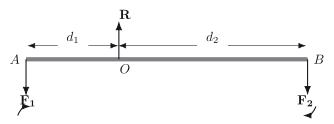
Drawn by us to help you understand the concept clearly, and verified to make sure it's accurate. For exams, practice from your textbook's own diagram.
The figure shows a horizontal, light rod AB that can rotate freely about a fixed pivot O. At point A, a load acts vertically downward. At point B, an effort also acts vertically downward. The pivot O exerts an upward reaction force on the rod. The distances from the pivot to the points of application are labelled: is the perpendicular distance from O to the line of action of (the load arm), and is the perpendicular distance from O to the line of action of (the effort arm). The rod itself is assumed to be light, meaning its own weight is negligible compared to and .
The physical idea is the lever — one of the simplest machines. The rod is in equilibrium under the action of three forces: the load, the effort, and the reaction at the fulcrum. Because the rod is not translating, the net force on it must be zero. Because it is not rotating, the net torque about any point must also be zero. The figure is the classic setup for deriving the mechanical advantage of a lever.
The textbook uses this figure to develop the condition for rotational equilibrium. Taking torques about the fulcrum O eliminates the reaction (since its lever arm is zero), giving the key relation:
Here, is the load (the weight being lifted), is the load arm (distance from fulcrum to load), is the effort (the force applied), and is the effort arm (distance from fulcrum to the point where effort is applied). The product is the magnitude of the torque (or moment) about the pivot. The equation states that for equilibrium, the clockwise torque due to the load must equal the anticlockwise torque due to the effort.
The reaction at the fulcrum is not zero. From the force equilibrium condition (vertical forces), . The torque equation above is valid only because we chose the pivot point O as the axis — the torque of about O is zero. If you take torques about any other point, you must include the torque due to . …