Q.Find the centre of mass of a triangular lamina.
You're viewing a preview — the full solution, concept, methods & PYQ mapping are locked.
Start your 14-day free trial to unlock the full solution →The centre of mass of a uniform triangular lamina lies at its centroid — the intersection of the three medians. For a triangle with vertices at , , , the coordinates are .
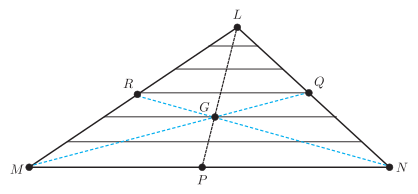
The figure shows triangle LMN with its three medians drawn as dashed lines: LP from vertex L to the midpoint of side MN, MQ from vertex M to the midpoint of side LN, and NR from vertex N to the midpoint of side LM. These three medians intersect at a single point labelled G — the centroid of the triangle. The base MN is drawn horizontally, and several thin strips parallel to MN are shown inside the triangle, running from one side to the other.
The physical idea is straightforward: to find the centre of mass of a uniform triangular lamina, you can treat it as a collection of thin strips parallel to one side. Each strip is uniform and has its own centre of mass at its midpoint. Because the strips are parallel to the base MN, all their midpoints lie along the median from the opposite vertex — in this case, the median LP. The centre of mass of the whole triangle must lie somewhere on that median, since it is the weighted average of the positions of all the strips. By the same reasoning, if you repeat the process with strips parallel to another side, the centre of mass must also lie on that side's median. The only point that lies on all three medians is their intersection — the centroid G. So for a uniform triangular lamina, the centre of mass coincides with the centroid.
The key result the textbook develops with this figure is the location of the centroid along each median. The centroid divides each median in the ratio 2:1, with the longer segment from the vertex to the centroid. If the vertices have position vectors , , and , the position vector of the centroid (and hence the centre of mass) is:
Here , , are the position vectors of the three vertices relative to any chosen origin. The formula gives the average of the vertex coordinates, which is exactly the centroid. For a uniform lamina, this is the centre of mass because every point in the triangle is weighted equally by its area.
This result holds only for a uniform triangular lamina — constant mass per unit area. If the lamina has non-uniform density, the centre of mass will not generally be at the centroid.
To find the centre of mass of any uniform triangular lamina quickly, just average the coordinates of the three vertices. No integration is needed — the median argument guarantees it.
Why the centre of mass of a triangle is its centroid
A lamina is a thin, flat sheet. If it's uniform (same density everywhere), its centre of mass is the same as its centroid — the geometric centre of the shape. For a triangle, the centroid is the point where the three medians meet.
Why medians? Because a median divides the triangle into two equal areas. If you balance the triangle on a line, that line must split the area equally — otherwise one side would be heavier. The only lines that always split area equally through a vertex are the medians. The centre of mass must lie on every median, so it lies at their intersection.
For any uniform lamina, the centre of mass coincides with the centroid. This is true only when density is constant — if the lamina were denser on one side, the centre of mass would shift.
Finding the coordinates
Let’s place the triangle in the -plane with vertices , , .
-
Divide the triangle into thin strips parallel to one side.
Imagine slicing the triangle into many thin horizontal strips (parallel to base ). Each strip is approximately a rectangle of infinitesimal height . The centre of mass of each strip lies at its midpoint.
-
Use the principle of weighted averages.
The centre of mass is given by:
For a uniform lamina, is proportional to area , so we replace with (the constant density cancels).
-
Set up coordinates to simplify integration.
Place the triangle with base along the -axis from to , and apex at . This is a right triangle — but the result will be general because any triangle can be transformed by an affine map that preserves ratios of areas.
The width of the triangle at height (from the base) varies linearly:
So a thin strip at height has area .
- Find first (vertical coordinate). The total area . The first moment about the -axis is:
Therefore:
The centre of mass is one-third of the height from the base.
- Find (horizontal coordinate). …
Unlock everything free for 14 days
- Full step-by-step solutions
- Concept-first explanations
- Methods, shortcuts & mistakes
- PYQ mapping + timed mock tests
Full access for 14 days. No credit card required.