Chemistry · Ch 7 — Alcohols, Phenols and Ethers
Structures of Functional Groups
Structures of Functional Groups
Why the Oxygen Atom Is Bent, Not Linear
The functional-group oxygen in alcohols, phenols and ethers is always hybridised — the same hybridisation state as the oxygen in a water molecule. Because two of its four orbitals hold lone pairs and only two form bonds, the group is bent rather than linear.
In an alcohol, the C–O bond is a sigma () bond formed by the head-on overlap of an hybrid orbital on carbon with an hybrid orbital on oxygen. The O–H bond is a second bond formed the same way, between oxygen and hydrogen. So around the oxygen atom in R–OH there are two bond pairs (to C and to H) and two lone pairs, all occupying roughly tetrahedral directions — exactly the water-like geometry.
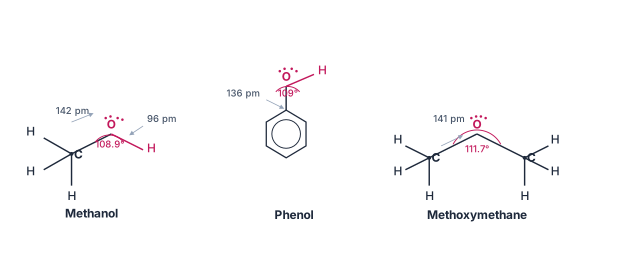
Fig. 7.1 in the textbook lays this out for three representative molecules — methanol, phenol and methoxymethane — marking the measured C–O bond length and the C–O–H (or C–O–C) bond angle for each. The numbers below are read directly off that figure; the point of studying them is to see how the same linkage stretches or bends slightly depending on what is attached to it.
Drawn by us to help you understand the concept clearly, and verified to make sure it's accurate. For exams, practice from your textbook's own diagram.
Figure 7.1 is a structural diagram that compares the three functional groups central to the chapter: the hydroxyl group in an alcohol (methanol) and a phenol, and the ether linkage in methoxymethane. The figure does not plot data on axes; instead, it presents ball-and-stick or line-bond models of each molecule, with key bond lengths and bond angles labelled directly on the structures.
What the figure shows for each molecule:
-
Methanol (): The central oxygen is bonded to a carbon and a hydrogen. The C–O bond length is 142 pm, the O–H bond length is 96 pm, and the C–O–H bond angle is 108.9°. Two lone pairs on oxygen are shown, and the angle is slightly less than the tetrahedral angle () due to lone-pair–bond-pair repulsion.
-
Phenol (): The –OH group is attached to an -hybridised carbon of the benzene ring. The C–O bond length is 136 pm — noticeably shorter than in methanol. The C–O–H bond angle is 109°. The shorter bond arises from partial double-bond character: the oxygen’s lone pair conjugates with the aromatic -system, and the carbon is -hybridised (which has more s-character, making bonds shorter).
-
Methoxymethane (): The oxygen is bonded to two carbon atoms. Each C–O bond length is 141 pm, and the C–O–C bond angle is 111.7° — slightly larger than the tetrahedral angle. This increase is due to steric repulsion between the two bulky methyl groups.
Physical idea taught:
The figure illustrates how hybridisation and conjugation affect bond lengths and angles. In phenol, conjugation with the ring shortens the C–O bond. In ethers, the larger alkyl groups push the bond angle open. In all three, the oxygen’s two lone pairs keep the geometry near tetrahedral, but deviations arise from electronic and steric factors.
Key formula(s) developed with this figure:
The textbook uses these structural parameters to explain the bond angle in alcohols and ethers. The tetrahedral angle is (or ). The observed angles are:
- For alcohols: (slightly less than tetrahedral)
- For ethers: (slightly greater than tetrahedral) …
The Bond Angle in Alcohols
For methanol, , Fig. 7.1 records:
A perfect tetrahedral angle is (i.e., about ). The alcohol's C–O–H angle is a shade smaller than this. The reason is the same one used to explain why the H–O–H angle in water is less than tetrahedral: oxygen's two lone pairs repel each other, and a lone pair–lone pair repulsion is stronger than a lone pair–bond pair or bond pair–bond pair repulsion. That extra push squeezes the bonded groups (C and H) slightly closer together, shrinking the angle just below the ideal tetrahedral value.
The Bond Angle and Bond Length in Phenols
In phenol, the oxygen is not attached to an ordinary carbon — it sits on a ring carbon that is itself hybridised, since it is part of the aromatic system. Fig. 7.1 gives:
The angle is close to the alcohol value, but the C–O bond length is noticeably shorter than the 142 pm seen in methanol. Two things together are responsible for this shortening:
- Partial double-bond character. One of oxygen's lone pairs can delocalise into the aromatic ring — the lone pair conjugates with the ring's system (this resonance donation is what drives phenol's characteristic chemistry, taken up later in Section 7.4.4). Because some electron density from that lone pair is pulled into -type overlap with the ring, the C–O bond acquires a little double-bond character, and a bond with more double-bond character is shorter than a pure single bond.
- The carbon is , not . An orbital has more -character than an orbital, which pulls its electron density closer to the carbon nucleus. A bond built from a higher--character orbital is inherently shorter.
Both effects act in the same direction, so the phenolic C–O bond is measurably tighter than the alcohol's C–O bond even though the two O–H ends look outwardly similar.
The Bond Angle and Bond Length in Ethers
In an ether, R–O–R, oxygen again carries four electron pairs — but now both of the bonded partners are carbon groups rather than one carbon and one hydrogen. Fig. 7.1 illustrates this with methoxymethane (dimethyl ether):
The four electron pairs — two bond pairs and two lone pairs — are still arranged in an approximately tetrahedral pattern around oxygen, but this time the C–O–C angle is slightly larger than the tetrahedral angle rather than smaller. The reason is steric, not electronic: the two groups on either side of the ether oxygen are bulkier than a single hydrogen atom, so their mutual repulsion pushes them a little further apart, widening the angle beyond . …