Chemistry · Ch 8 — Aldehydes, Ketones and Carboxylic Acids
Introduction
Introduction
What this chapter covers
By the end of this chapter, you should be able to:
- Name aldehydes, ketones, and carboxylic acids using both common and IUPAC conventions.
- Draw the structures of compounds built around the carbonyl group () and the carboxyl group ().
- Describe the major methods used to prepare aldehydes, ketones, and carboxylic acids, and the reactions they undergo.
- Connect the physical properties and chemical behaviour of these compounds to their underlying structure.
- Follow the mechanism of a few selected aldehyde and ketone reactions.
- Explain the factors that affect the acidity of carboxylic acids and how these factors shape their reactions.
- Recognise common uses of aldehydes, ketones, and carboxylic acids.
Why carbonyl compounds matter
Carbonyl compounds are central to organic chemistry — they turn up as building blocks of fabrics, flavourings, plastics, and drugs.
The previous chapter dealt with organic compounds built around a carbon-oxygen single bond (alcohols, phenols, and ethers). This chapter turns to compounds built around a carbon-oxygen double bond, , known as the carbonyl group — one of the most important functional groups in organic chemistry.
- Where the carbonyl carbon is bonded to a carbon (or hydrogen) atom and a hydrogen atom, the compound is an aldehyde, written .
- Where the carbonyl carbon is bonded to two carbon atoms, the compound is a ketone.
- Where the carbonyl carbon instead carries an oxygen from a hydroxyl () group, the result is the carboxyl group, and the compound is a carboxylic acid.
- Two related families branch off the same carboxyl carbon: swapping the for a nitrogen-based group gives an amide, and swapping it for a halogen gives an acyl halide. Esters and anhydrides are likewise built as derivatives of carboxylic acids.
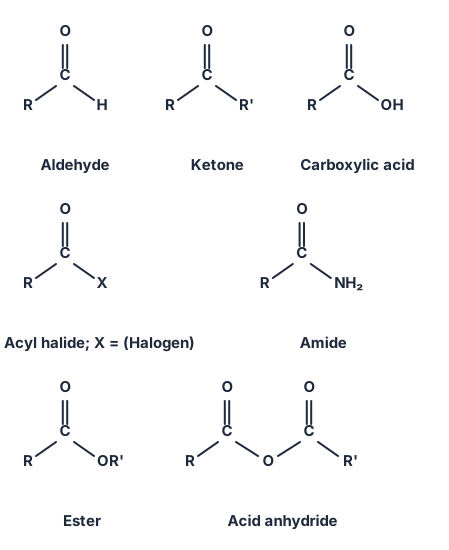
Drawn by us to help you understand the concept clearly, and verified to make sure it's accurate. For exams, practice from your textbook's own diagram.
Redrawn from the NCERT page with the structures, printed labels (O, C, R, H, R', OH, X, NH2, OR') and reagent placement exactly as the textbook prints them. Every element of this display was checked against the printed page during the sweep's blind-judge verification pass, so what you practise from here matches your textbook.
Aldehydes, ketones, and carboxylic acids are not confined to the laboratory — they occur widely across the plant and animal kingdoms and play a genuine role in biochemical processes. Several owe their pleasant natural fragrances to specific carbonyl compounds: vanillin (from vanilla beans), salicylaldehyde (from meadow sweet), and cinnamaldehyde (from cinnamon bark) are all aldehydes valued for their scent.
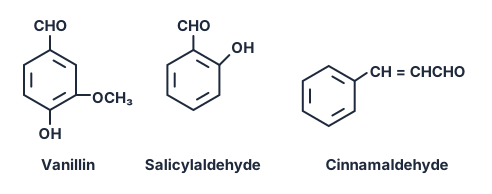
Drawn by us to help you understand the concept clearly, and verified to make sure it's accurate. For exams, practice from your textbook's own diagram.
Redrawn from the NCERT page with the structures, printed labels (CHO, OCH3, OH, CH = CHCHO) and reagent placement exactly as the textbook prints them. Every element of this display was checked against the printed page during the sweep's blind-judge verification pass, so what you practise from here matches your textbook.
This natural abundance is part of why many of these compounds are also manufactured deliberately — as solvents (acetone is a familiar example), and as starting materials for adhesives, paints, resins, perfumes, plastics, and fabrics.