Chemistry · Ch 8 — Aldehydes, Ketones and Carboxylic Acids
Physical Properties
Physical Properties
Physical State and Odour
Among the carbonyl compounds, methanal (formaldehyde) is a gas at ordinary room temperature, while ethanal (acetaldehyde) is a liquid so volatile that it boils just above room temperature. All the remaining aldehydes and ketones exist as liquids or solids under normal conditions.
Smell follows a similar trend with size. The lower-molecular-mass aldehydes have a sharp, pungent odour, but as the hydrocarbon part of the molecule grows longer, the smell turns milder and increasingly pleasant — many naturally occurring aldehydes and ketones are, in fact, valued for their fragrance and are used in perfumery and as flavouring agents.
Boiling Points
The carbonyl group () is strongly polar, and this polarity lets neighbouring carbonyl molecules weakly associate through dipole-dipole interactions. As a result:
-
Aldehydes and ketones boil at higher temperatures than hydrocarbons or ethers of comparable molecular mass. A hydrocarbon or an ether has no comparable permanent dipole to hold its molecules together, so only weak van der Waals forces act between them, whereas the dipole-dipole attraction in a carbonyl compound needs extra thermal energy to overcome.
-
Aldehydes and ketones boil at lower temperatures than alcohols of comparable molecular mass. An alcohol molecule carries an bond, so alcohol molecules can hydrogen-bond directly with one another. A carbonyl compound has no such hydrogen to donate, so this stronger, intermolecular hydrogen bonding is simply not available between two aldehyde or ketone molecules — dipole-dipole attraction is the strongest force they can offer each other.
So, for molecules of similar mass, the order of increasing boiling point runs roughly as:
This pattern can be checked against a short set of compounds of nearly identical molecular mass (58–60 u) — an alkane, an ether, an aldehyde, a ketone, and an alcohol — whose measured boiling points, taken together, confirm exactly this ordering:
| b.p.(K) | Molecular Mass | |
|---|---|---|
| n-Butane | 273 | 58 |
| Methoxyethane | 281 | 60 |
| Propanal | 322 | 58 |
| Acetone | 329 | 58 |
| Propan-1-ol | 370 | 60 |
Solubility in Water
Even though a carbonyl compound cannot hydrogen-bond with another molecule of itself, it can hydrogen-bond with water. The oxygen of the group carries lone pairs of electrons and a partial negative charge (), which lets it accept a hydrogen bond from the partially positive () hydrogen of a water molecule:
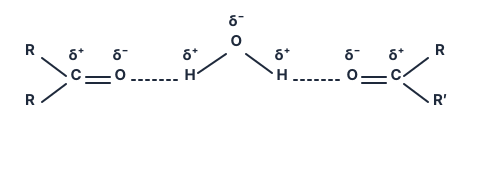
Drawn by us to help you understand the concept clearly, and verified to make sure it's accurate. For exams, practice from your textbook's own diagram.
Redrawn from the NCERT page with the structures, printed labels () and reagent placement exactly as the textbook prints them. Every element of this display was checked against the printed page during the sweep's blind-judge verification pass, so what …
Because of this interaction with water, the lower members of the series — methanal, ethanal, and propanone — are miscible with water in all proportions. …