Q.State Wheatstone bridge principle. Use Kirchhoff's Laws to obtain the relation between the resistance in four arms of the Wheatstone bridge by drawing circuit diagram.
🔒You're viewing a preview — the full solution, concept, methods & PYQ mapping are locked.
🔒 Start your 14-day free trial to unlock the full solution →Concept understanding — Wheatstone Bridge
The Wheatstone Bridge – From Intuition to Precision
Imagine you have a single unknown resistor and you want to find its value. You could use an ohmmeter, but those are not always accurate for very small or very large resistances. A more elegant method is to compare it against known resistances in a circuit that acts like a balance scale — that is the Wheatstone bridge.
The core idea is simple: make the voltage at two points equal, so no current flows between them. When that happens, you know the ratio of the resistances.
The Circuit Layout
The bridge has four resistors arranged in a diamond shape:
        A
       / \
      P   Q
     /     \
    B-------C
     \     /
      R   S
       \ /
        D
A battery is connected across A and D. A sensitive galvanometer (G) is connected between B and C. The four resistors are labelled P, Q, R, and S. Usually, three are known and one (say, S) is unknown.
The Intuition: Two Voltage Dividers
Look at the left side: from A to D through P and R. That is a voltage divider. The voltage at B is a fraction of the battery voltage, determined by the ratio of P to R.
Now look at the right side: from A to D through Q and S. That is another voltage divider. The voltage at C is a fraction of the battery voltage, determined by the ratio of Q to S.
If the voltage at B equals the voltage at C, then no current flows through the galvanometer — the bridge is balanced.
The Condition for Balance
When the bridge is balanced, the voltage drop across P equals the voltage drop across Q (since both start at A), and the voltage drop across R equals the voltage drop across S (since both end at D). From the voltage divider rule:
- Voltage at B: VB=VA⋅P+RR
- Voltage at C: VC=VA⋅Q+SS
Setting VB=VC gives:
P+RR=Q+SS
Cross-multiply:
R(Q+S)=S(P+R)
RQ+RS=SP+SR
The RS terms cancel, leaving:
RQ=SP
Or, rearranged:
QP=SR
QP=SR
That is the balance condition of the Wheatstone bridge. When this holds, the galvanometer shows zero deflection.
Measuring an Unknown Resistance
Suppose S is unknown. You set P, Q, and R to known values. You adjust R (or the ratio P/Q) until the galvanometer reads zero. Then you compute:
S=PQ⋅R
This is why the bridge is so useful: you do not need to measure current or voltage accurately — you only need to detect when current is zero. That is far more sensitive and precise.
In practice, P and Q are often made equal (a 1:1 ratio), so the unknown S simply equals R. This is the "equal-arm" bridge.
Why It Works So Well
The galvanometer is a null detector — it only tells you whether current is flowing, not how much. This eliminates errors from meter calibration, battery voltage fluctuations, and temperature effects. The accuracy depends only on the precision of the known resistors. …
At balance no current flows through the galvanometer, so the same current runs through each pair of arms, and applying Kirchhoff's loop rule to the two halves yields a ratio condition among the four resistances. …
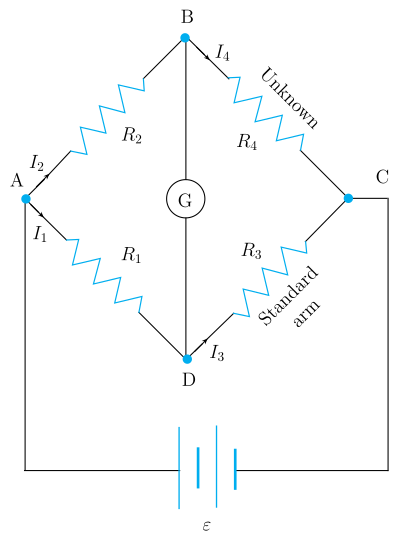
A Wheatstone bridge balances when the ratio of resistances in one pair of arms equals the ratio in the other pair, giving zero galvanometer deflection — derived directly from Kirchhoff's two laws.
Wheatstone bridge principle: it is a four-arm resistance network (arms P, Q, R, S) with a galvanometer connected between the midpoints of two opposite arms, and a battery across the other diagonal. The bridge is said to be balanced when no current flows through the galvanometer.
Circuit: Let the four arms be P (A to B), Q (B to C), R (A to D), S (D to C), with the battery connected between A and C, and the galvanometer (with resistance G) between B and D. Current I1 flows through P and Q, and I2 through R and S; at balance, the galvanometer current Ig=0.
Using Kirchhoff's laws:
- Junction rule at B: current entering B (I1, through P) splits into the galvanometer branch (Ig) and Q. At balance Ig=0, so the same current I1 continues through both P and Q. Similarly at D, the same current I2 continues through both R and S. …
- CBSE 2026Set 55/3/11 markMCQQ.Assertion (A) : In a Wheatstone bridge circuit, if we interchange the position of the cell and the galvanometer, the balance condition QP=SR remains unchanged. Reason (R) : QP=SR⇒PQ=RS, so the balance condition remains the same. (A) Both Assertion (A) and Reason (R) are true and Reason (R) is the correct explanation of the Assertion (A). (B) Both Assertion (A) and Reason (R) are true, but Reason (R) is not the correct explanation of the Assertion (A). (C) Assertion (A) is true, but Reason (R) is false. (D) Both Assertion (A) and Reason (R) are false.
›Reveal solutionSolution
The assertion is true because the Wheatstone bridge is a reciprocal network, but the reason given (a trivial algebraic manipulation) does not explain why interchanging the cell and galvanometer preserves balance. The correct option is (B).
The Wheatstone bridge is a beautiful example of a reciprocal circuit. When balanced, no current flows through the galvanometer because the potential difference across it is zero. The question asks whether swapping the positions of the cell and galvanometer affects this balance condition.
The assertion claims the balance condition QP=SR remains unchanged after the swap. This is indeed true, and follows from the reciprocity theorem in circuit theory: in a linear, bilateral network (one with resistors only, no diodes or other one-way elements), interchanging a voltage source and a current-measuring device does not change the current through the measuring device.
The reason given, however, is just the algebraic statement that QP=SR implies PQ=RS. While mathematically correct, this doesn't explain anything about the physical interchange of components. It's a red herring.
Let me show why the assertion is actually true:
-
Original configuration: The cell is connected between two opposite nodes (say A and C), and the galvanometer between the other two (B and D). At balance, the potentials at B and D are equal, so VB=VD.
-
Deriving the balance condition: Using voltage dividers along the two arms:
VB=VA+P+QQ(VC−VA),VD=VA+R+SS(VC−VA)
Setting VB=VD gives P+QQ=R+SS, which simplifies to QP=SR.
-
After interchange: Now the cell is between B and D, and the galvanometer between A and C. For balance, we need VA=VC (no current through the galvanometer).
-
New balance condition: With the cell across B–D, we can write: …
-
- CBSE 2026Set V11 markMCQQ.Consider the following statements about a balanced Wheatstone's bridge. Statement-I : The current through the galvanometer is zero. Statement-II : If the positions of the galvanometer and the battery are interchanged in the circuit, the current in the galvanometer will be zero. Among the above two statements :(a) Only Statement-I is true(b) Only Statement-II is true(c) Both the Statements are wrong(d) Both the Statements are true
›Reveal solutionSolution
(d) Both the Statements are true …
- CBSE 2026Set SEM31 markMCQQ.In which case will the null condition of a Wheatstone bridge change ?(a) If the resistances in different arms are changed(b) If the positions of the battery and the galvanometer are interchanged(c) If a battery of different emf is used(d) If a galvanometer of different resistance is used
›Reveal solutionSolution
A Wheatstone bridge is balanced when P/Q = R/S — only the four arm resistances matter. Changing an arm's resistance upsets balance; interchanging the cell and galvanometer, or changing their values/emf, does not. Option (a).
Step 1 — balance condition (NCERT/CBSE Class 12 Physics, Current Electricity): P/Q = R/S for the four ratio arms.
Step 2 — evaluate each option:
- (a) Changing arm resistances alters the P/Q or R/S ratio → balance changes. This is the correct choice. …
- CBSE 2025Set ANNUAL1 markQ.What is balanced condition of Wheatstone bridge ?
›Reveal solutionSolution
A Wheatstone bridge is balanced when the ratio of resistances in the two arms is equal on both sides, so the galvanometer carries no current.
A Wheatstone bridge has four resistances P, Q, R, S arranged in a diamond, with a galvanometer connected across the middle (between the P–Q junction and the R–S junction) and a battery driving current through the outer loop. The bridge is said to be balanced when the potential at the galvanometer's two terminals is equal, so no current flows through it (Ig=0).
…
- CBSE 2025Set ANNUAL1 markMCQQ.Wheatstone bridge is used to measure :(a) e.m.f.(b) potential(c) resistance(d) current
›Reveal solutionSolution
A Wheatstone bridge is a four-arm resistance network used to accurately measure an unknown resistance by balancing it against three known resistances.
The Wheatstone bridge consists of four resistors arranged in a diamond/quadrilateral, with a galvanometer connected across one diagonal and a battery across the other. By adjusting the known resistances until the galvanometer shows zero deflection (balanced condition, P/Q=R/S), the unknown resistance can be calculated precisely from the …
- CBSE 2025Set ANNUAL1 markMCQQ.In the circuit, it is given that AB = 6 Ω, BC = 3 Ω, CD = 6 Ω, DA = 12 Ω and G = 10 Ω. Current through the galvanometer will be(a) 8.7 mA(b) 7.8 mA(c) 8.7 A(d) 0 A
›Reveal solutionSolution
The Wheatstone-bridge balance condition AB/BC = AD/DC is satisfied exactly, so no current flows through the galvanometer.
For the bridge A-B-C-D with the galvanometer across the B-D diagonal, the bridge is balanced when
BCAB=DCAD
Here AB=6Ω, BC=3Ω, AD=12Ω, DC=6Ω:
36=2,612=2 …
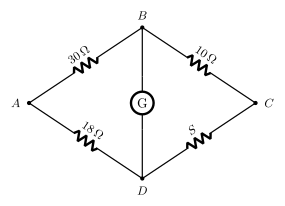
- CBSE 2024Set ANNUAL1 markMCQQ.In the given figure, if the Wheatstone bridge is in balanced condition, then the value of resistance 'S' will be -(a) 12 Ω(b) 9 Ω(c) 3.0 Ω(d) 6 Ω
›Reveal solutionSolution
In a balanced Wheatstone bridge, the ratio of the two arms on one side equals the ratio on the other side: P/Q = R/S.
Label the bridge arms as given: AB = P = 30 Ω, BC = Q = 10 Ω, AD = R = 18 Ω, DC = S (unknown), with the galvanometer connected between B and D.
For a balanced Wheatstone bridge (no current through the galvanometer), the balance condition is:
…
- CBSE 2021Set OC1 markQ.State the principle of a Wheatstone bridge.
›Reveal solutionSolution
The Wheatstone bridge principle: four resistances arranged in a closed network are "balanced" (zero galvanometer current) exactly when the ratio of resistances in one pair of adjacent arms equals that of the other pair.
A Wheatstone bridge consists of four resistances P,Q,R,S forming a closed quadrilateral (arms AB=P, BC=Q, AD=R, DC=S), with a battery connected across one diagonal (A–C) and a galvanometer across the other diagonal (B–D).
The bridge is said to be balanced when the galvanometer shows no deflection, i.e. no current flows through the BD arm — this happens when points B and D are at the same potential.
Under this balanced condition, applying Kirchhoff's laws to the two loops gives the principle:
…
- CBSE 2019Set ANNUAL1 markMCQQ.If R is the resistance of each side and that of galvanometer of a balanced Wheatstone bridge, then total resistance across the terminals connecting the battery is(a) R(b) 2R(c) R/2(d) R/4
›Reveal solutionSolution
Balanced bridge → galvanometer carries no current; the network reduces to two 2R branches in parallel = R: option (a).
In a balanced Wheatstone bridge, the bridge (galvanometer) arm carries no current, because the potentials at its two ends are equal. Therefore the galvanometer branch can be removed without changing anything.
…
🎓Unlock everything free for 14 days
- ✓Full step-by-step solutions
- ✓Concept-first explanations
- ✓Methods, shortcuts & mistakes
- ✓PYQ mapping + timed mock tests
Full access for 14 days. No credit card required.