Physics · Ch 2 — Electrostatic Potential and Capacitance
Potential Energy of a System of Charges
Potential Energy of a System of Charges
Why Potential Energy Exists for a System of Charges
Electrostatic force is conservative. This means the work done to assemble a group of charges from infinity does not depend on the path taken. This work is stored as electrostatic potential energy of the system. The energy belongs to the configuration of charges, not to any single charge.
Step 1: Potential Energy of Two Point Charges
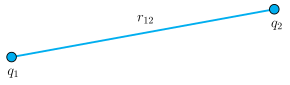
Consider two charges and at positions and , separated by distance .
- Bring from infinity to : No work is needed because there is no other charge to create a field.
- Bring from infinity to : The charge already creates a potential at given by:
Work done on is .
This work is stored as potential energy of the two-charge system:
Key points:
- The result is independent of the order of bringing charges.
- If (like charges), — work is done against repulsion.
- If (unlike charges), — work is done by the attractive field (negative work by external agent).
Step 2: Generalisation to Three Point Charges
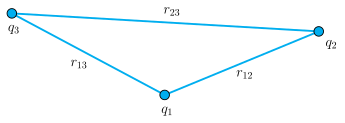
For charges at positions :
- Bring : Zero work.
- Bring : Work = .
- Bring : Now both and create a potential at :
Work done on = .
Adding all contributions gives the total potential energy:
Important: The result is path-independent — it depends only on the final positions, not on the assembly order.
Step 3: Example — Four Charges at Corners of a Square
Given: Square of side , charges at corners respectively.
(a) Work to assemble the arrangement:
One valid order: bring to , then to , then to , then to .
- Step (i):
- Step (ii):
- Step (iii): …
Drawn by us to help you understand the concept clearly, and verified to make sure it's accurate. For exams, practice from your textbook's own diagram.
What the figure shows
The diagram is a minimal schematic of two point charges. A single straight line segment runs from the lower‑left to the upper‑right. At the lower‑left endpoint is a small circle labelled ; at the upper‑right endpoint is another small circle labelled . Above the middle of the segment is the label . There are no axes, no field lines, and no other markings.
Physical idea
The figure illustrates the simplest possible system of point charges: just two of them. The quantity is the distance between the two charges. The diagram is used to introduce the concept of electrostatic potential energy of a system — the work stored when the charges are brought from infinity to their present positions. The key point is that this energy depends only on the product of the charges and the separation between them, not on the path taken to assemble them.
Key formula
The textbook derives the potential energy for two point charges as:
where:
- is the electrostatic potential energy of the system (in joules)
- is the permittivity of free space ()
- and are the magnitudes of the two charges (with sign)
- is the distance between the centres of the two charges …
Drawn by us to help you understand the concept clearly, and verified to make sure it's accurate. For exams, practice from your textbook's own diagram.
Figure 2.14 is a schematic diagram of three point charges — , , and — placed at the vertices of a scalene triangle. There are no axes; the figure is a pure geometric sketch. Each charge is represented by a small circle at a vertex: at the top-left, at the right, and at the bottom. The sides of the triangle are labelled with the distances between the corresponding charges: (between and ) on the lower-right side, (between and ) on the lower-left side, and (between and ) on the top-left side.
The physical idea the figure teaches is that the total electrostatic potential energy of a system of three point charges is the sum of the pairwise potential energies for each distinct pair. Because electrostatic force is conservative, the work done to assemble the configuration is independent of the order in which the charges are brought from infinity. The figure visually reminds us that every pair of charges contributes a term, and the total energy depends only on the final positions (the distances , , ) and the product of the charges in each pair. …