Q.(a) Draw equipotential surfaces for a positive point charge.
You're viewing a preview — the full solution, concept, methods & PYQ mapping are locked.
Start your 14-day free trial to unlock the full solution →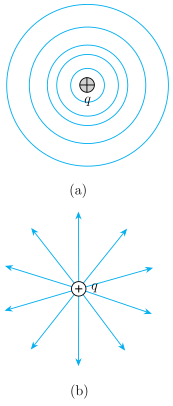
(a) A point charge's equipotentials are concentric spheres. (b) The dipole potential formula gives zero on the equatorial plane, since every point there is equidistant from both charges.
(a) Equipotential surfaces of a positive point charge:
Since the potential of a point charge at distance is , which depends only on , every point at the same distance from the charge has the same potential. The equipotential surfaces are therefore a family of concentric spheres centred on the charge, with potential decreasing as the radius increases (surfaces farther from the charge have lower potential, spaced progressively farther apart for equal potential steps).
(b) Electric potential — definition and dipole derivation:
Definition: Electric potential at a point in an electrostatic field is the work done per unit positive test charge in bringing it from infinity to that point, without acceleration:
Derivation for a dipole: consider a dipole with charges at A and at B, separated by , dipole moment . Let P be a point at distance from the centre O of the dipole, at angle from the dipole axis, with .
Let = distance from to P, = distance from to P. The total potential at P (superposition of the two point-charge potentials):
…
Unlock everything free for 14 days
- Full step-by-step solutions
- Concept-first explanations
- Methods, shortcuts & mistakes
- PYQ mapping + timed mock tests
Full access for 14 days. No credit card required.