Q.Suppose that the lower half of the concave mirror's reflecting surface in Fig. 9.6 is covered with an opaque (non-reflective) material.
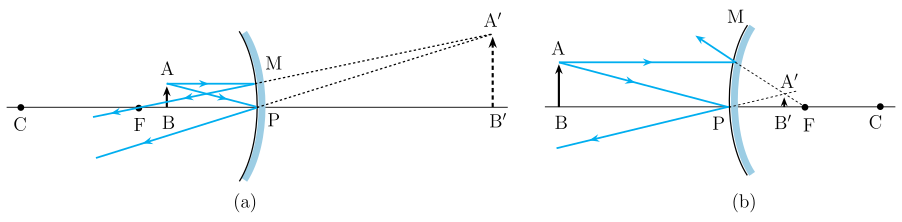
Covering half the mirror reduces the intensity of the reflected light but does not change the position, size, or nature of the image — the image becomes dimmer but is otherwise identical.
The key insight is that every point on a mirror obeys the law of reflection independently. When you cover the lower half, you are simply removing some of the rays that would have reached the image point. The remaining rays from the upper half still converge (or appear to diverge from) exactly the same image location.
Think of it this way: a concave mirror forms an image because rays from each object point, after reflection, meet at a corresponding image point. Each ray path is determined solely by the geometry of the mirror surface at the point where it hits. If you block half the mirror, you lose half the rays — but the rays that do reflect still follow the same paths and still meet at the same image point. The image is simply formed by fewer rays, so it is less bright.
A common misconception is that covering half the mirror will cut off half the image — like covering half a camera lens. But a mirror is not a lens. A lens focuses light by refraction through its entire aperture; covering half a lens can indeed distort or shift the image. A mirror, however, is a reflective surface where each point acts independently. The image location depends only on the mirror's curvature and the object position, not on which part of the mirror is used.
Let's work through the specific case shown in Figure 9.6(a) — a concave mirror with the object between the pole and the focus.
-
Identify the image formed by the full mirror.
For an object placed between and of a concave mirror, the ray diagram shows that reflected rays diverge. Their backward extensions meet behind the mirror, forming an erect, magnified, virtual image . This is the standard result.
-
Now cover the lower half.
Consider a specific object point, say at the top of the arrow. In the full mirror, rays from strike both the upper and lower halves of the mirror. After covering the lower half, only rays hitting the upper half remain. But each of these remaining rays still obeys the law of reflection at its point of incidence. Their backward extensions still meet at the same point as before — because the geometry of the mirror surface at those points hasn't changed.
-
Repeat for every object point.
The same reasoning applies to point and every point in between. The image location is unchanged. The only difference is that fewer rays contribute to forming each image point, so the image is dimmer.
-
What about the nature of the image?
Since the mirror's curvature and the object's position are unchanged, the image remains virtual, erect, and magnified. The covering does not alter the focal length or the mirror equation.
Do not confuse this with covering half a lens. A lens uses its entire aperture to bend light; covering half can shift the image or cause distortion. A mirror's image location depends only on the geometry of the reflecting surface at the points where rays actually hit — blocking some points simply reduces the number of rays.
A neat way to see this: take a small concave mirror and cover half of it with your finger. The image of your face in the mirror doesn't disappear or get cut in half — it just gets dimmer. Try it!
The image remains at the same position, with the same size and nature (virtual, erect, magnified), but becomes dimmer because fewer rays contribute to its formation.
Unlock everything free for 14 days
- Full step-by-step solutions
- Concept-first explanations
- Methods, shortcuts & mistakes
- PYQ mapping + timed mock tests
Full access for 14 days. No credit card required.