Q.Given in Fig. 5.11 are examples of some potential energy functions in one dimension. The total energy of the particle is indicated by a cross on the ordinate axis. In each case, specify the regions, if any, in which the particle cannot be found for the given energy. Also, indicate the minimum total energy the particle must have in each case. Think of simple physical contexts for which these potential energy shapes are relevant.
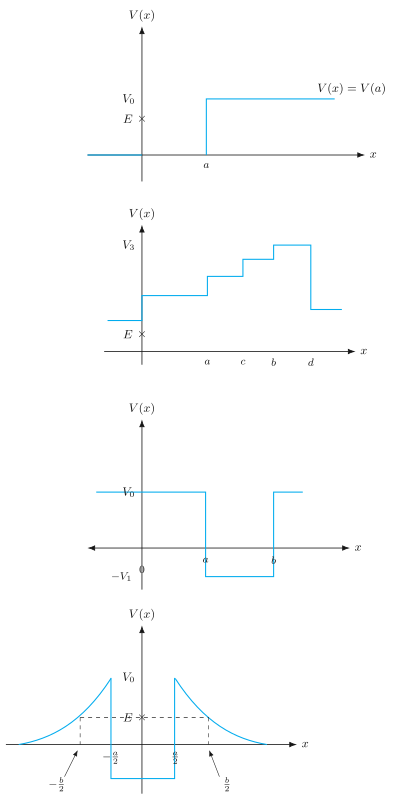
A particle can only be where its kinetic energy , i.e. where the total-energy level lies at or above the potential curve. Reading each graph: (a) forbidden for ; (b) forbidden everywhere for the marked ; (c) confined to ; (d) trapped in the central well and barred from the two barrier humps. The minimum total energy in each case equals the lowest point of that potential.
Concept
Total mechanical energy is constant, , so . Kinetic energy can never be negative, therefore the particle is allowed only where and forbidden wherever . The least total energy a particle can have equals the minimum value of (there ).
(a) Single upward step
For , , so the region is allowed. For , , giving , so the particle cannot be found for . The lowest potential is , so the minimum total energy is . Physical picture: a particle meeting a potential step, e.g. an electron approaching a metal boundary.
(b) Rising staircase
The marked energy lies below the whole curve ( for all ), so everywhere and the particle cannot be found anywhere with this energy. To be found even in its lowest broad region it needs , so the minimum total energy is . Physical picture: a charge driven through a succession of rising potential steps.
(c) Rectangular well
for and for , so those regions are forbidden; for , which is allowed. The particle is confined to , and the minimum total energy is (the floor of the well). Physical picture: a particle trapped in a box / finite square well, like a molecule bouncing between two rigid walls.
(d) Twin barriers with a central well
in the central well (allowed) and for (allowed), but each hump rises to . The particle is forbidden where the humps rise above , i.e. in and ; a particle sitting in the central well is classically trapped. The minimum total energy is . Physical picture: a particle bound in a well guarded by potential barriers, e.g. an -particle held inside a nucleus.
- cannot be found for ; .
- cannot be found anywhere for the marked energy; .
- confined to (barred from and ); .
- barred from the barrier regions and ; .
Unlock everything free for 14 days
- Full step-by-step solutions
- Concept-first explanations
- Methods, shortcuts & mistakes
- PYQ mapping + timed mock tests
Full access for 14 days. No credit card required.