Q.Answer the following:
You're viewing a preview — the full solution, concept, methods & PYQ mapping are locked.
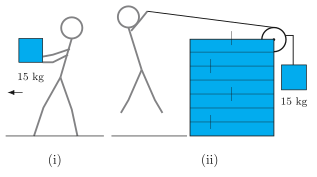
Start your 14-day free trial to unlock the full solution →Each part tests a different nuance of energy conservation and work. (a) The rocket's kinetic energy provides the heat. (b) Gravity is conservative — net work over a closed orbit is zero. (c) Loss of total energy shrinks the orbit, increasing speed. (d) Work is greater in case (ii) because the man must lift the mass against gravity.
(a) The burning casing — whose energy?
The key idea: energy is conserved. The heat that burns the casing must come from somewhere — it cannot be created from nothing.
The rocket is moving at high speed through the atmosphere. Friction (air resistance) does negative work on the rocket, converting its kinetic energy into thermal energy. That thermal energy heats the casing to the point of burning.
A common mistake is to think the atmosphere "gives" the energy. But the atmosphere is not a fuel source — it merely provides the force that dissipates the rocket's own kinetic energy.
So the heat energy comes at the expense of the rocket's kinetic energy (and hence its total mechanical energy). The atmosphere is just the medium that causes the dissipation.
(b) Zero work over a complete orbit — why?
Gravitational force is a conservative force. For any conservative force, the work done over a closed path is zero. That's the short answer.
But let's see why that's true for a comet. The gravitational force on the comet is always directed toward the Sun. Over one complete elliptical orbit, the comet returns to the same point with the same speed (by conservation of mechanical energy). The work-energy theorem says:
Since the comet's speed (and therefore kinetic energy) is the same at the start and end of a full orbit, , so .
Even though the force is not perpendicular to velocity at every instant, the net work over the whole orbit is zero because gravity is conservative. The work done while the comet moves toward the Sun (gaining speed) is exactly cancelled by the work done while it moves away (losing speed).
(c) Satellite losing energy but gaining speed — paradox?
This seems contradictory: if the satellite loses energy, shouldn't it slow down? The catch is that total mechanical energy is decreasing, but the satellite is also falling to a lower orbit.
For a satellite in a circular orbit of radius :
As energy becomes less negative (i.e., the satellite loses energy), decreases. But look at the kinetic energy: — as gets smaller, increases. So the satellite speeds up.
The lost energy goes into heating the atmosphere (dissipation). The satellite's potential energy decreases more than its kinetic energy increases, so total energy drops — but the kinetic energy itself rises.
--- …
Unlock everything free for 14 days
- Full step-by-step solutions
- Concept-first explanations
- Methods, shortcuts & mistakes
- PYQ mapping + timed mock tests
Full access for 14 days. No credit card required.