Q.Describe the structure of Anatropous ovule with diagram.
You're viewing a preview — the full solution, concept, methods & PYQ mapping are locked.
Start your 14-day free trial to unlock the full solution →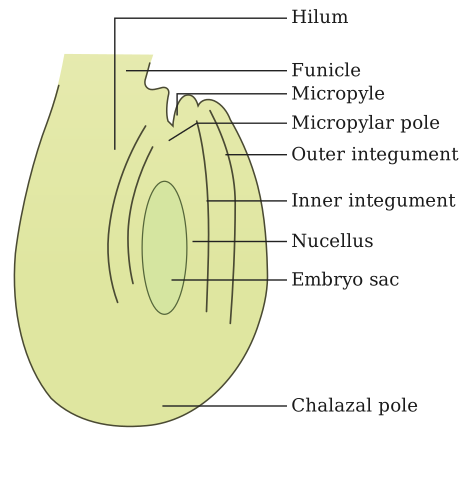
In an anatropous ovule - the commonest ovule type in flowering plants - the ovule body bends completely around during growth so that the micropyle and funicle end up adjacent, connected by the fused raphe.
Structure (diagram would show, from the point of attachment): the Funicle (stalk that attaches the ovule to the placenta) meets the ovule body at the Hilum. In the anatropous type, the body of the ovule curves through 180 degrees during development, so that the funicle becomes fused along the entire length of the ovule body, forming a longitudinal ridge called the Raphe. As a result, the Micropyle (the small pore through which the pollen tube enters) lies very close to the funicle/hilum, while the Chalaza (the basal region where the integuments and nucellus are fused/merge) lies at the far end, opposite the micropyle. Internally, the ovule is enclosed by one or two protective Integuments surrounding the Nucellus, inside which lies the Embryo sac (the 7-celled, 8- …
Unlock everything free for 14 days
- Full step-by-step solutions
- Concept-first explanations
- Methods, shortcuts & mistakes
- PYQ mapping + timed mock tests
Full access for 14 days. No credit card required.