Q.Classify the following as primary, secondary and tertiary alcohols:
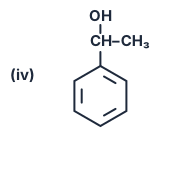
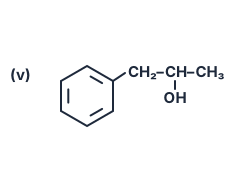
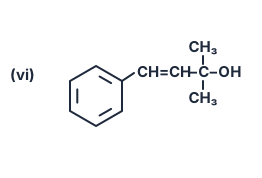
The classification of an alcohol as primary, secondary, or tertiary depends solely on the number of carbon atoms directly bonded to the carbon that carries the –OH group. Counting those neighbours gives the answer for each compound.
The core idea
In IUPAC nomenclature, the class of an alcohol is determined by the degree of substitution of the hydroxyl-bearing carbon. That carbon is called the carbinol carbon.
- If it is bonded to one carbon atom (and two hydrogens), the alcohol is primary (1°).
- If it is bonded to two carbon atoms (and one hydrogen), it is secondary (2°).
- If it is bonded to three carbon atoms (and no hydrogen), it is tertiary (3°).
The rest of the molecule — double bonds, rings, aromatic rings — does not change this rule. Only the immediate neighbours of the –OH carbon matter.
A common mistake is to count the total number of carbons in the molecule or to look at the complexity of the alkyl group. Ignore everything except the three bonds directly attached to the –OH carbon.
Step-by-step classification
1.
Draw the structure around the –OH carbon. The –OH is attached to a group. That carbon is bonded to:
- one carbon (the quaternary carbon )
- two hydrogens
Only one carbon neighbour → primary alcohol.
2.
The –OH is on the group at the end of the chain. That carbon is bonded to:
- one carbon (the of the double bond)
- two hydrogens
Again, only one carbon neighbour → primary alcohol. The double bond does not affect the classification.
3.
The –OH is on the terminal group. That carbon is bonded to:
- one carbon (the middle )
- two hydrogens
One carbon neighbour → primary alcohol.
4.
Here the –OH is on a group. That carbon is bonded to:
- one carbon from the group
- one carbon from the benzene ring ()
- one hydrogen
Two carbon neighbours → secondary alcohol.
5.
The –OH is on the group in the middle. That carbon is bonded to:
- one carbon from the group (which is attached to the benzene ring)
- one carbon from the group
- one hydrogen
Two carbon neighbours → secondary alcohol.
6.
The –OH is on a carbon that is part of a group. That carbon is bonded to:
- two groups (two carbons)
- one carbon from the chain
Three carbon neighbours → tertiary alcohol.
For compound (vi), the –OH carbon has no hydrogen attached — that is a dead giveaway for a tertiary alcohol. If you ever see a carbon with –OH and three other carbons around it, it is automatically 3°.
Final classification table
| Compound | –OH carbon neighbours | Class |
|---|---|---|
| (i) | 1 carbon | Primary |
| (ii) | 1 carbon | Primary |
| (iii) | 1 carbon | Primary |
| (iv) | 2 carbons | Secondary |
| (v) | 2 carbons | Secondary |
| (vi) | 3 carbons | Tertiary |
The classifications are: (i) primary,
(ii) primary,
(iii) primary,
(iv) secondary,
(v) secondary,
(vi) tertiary.
Unlock everything free for 14 days
- Full step-by-step solutions
- Concept-first explanations
- Methods, shortcuts & mistakes
- PYQ mapping + timed mock tests
Full access for 14 days. No credit card required.