Q.Predict the products of the following reactions:
You're viewing a preview — the full solution, concept, methods & PYQ mapping are locked.
Start your 14-day free trial to unlock the full solution →The key idea is that ethers cleave by protonation followed by nucleophilic attack; the site of cleavage depends on the carbocation stability (SN1 vs SN2) and the acid used. For (i) SN2 at the methyl carbon gives ;
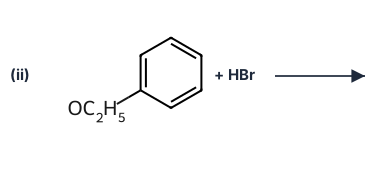
(ii) SN2 at the ethyl carbon gives ;
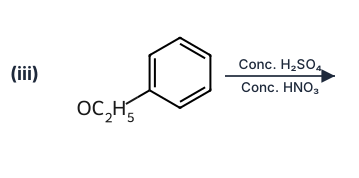
(iii) nitration occurs on the benzene ring, not ether cleavage;
(iv) SN1 at tertiary carbon gives .
The Concept: Why Ethers Cleave with HX
Ethers are generally unreactive, but strong acids like HBr, HI, or hot concentrated HX protonate the oxygen, turning the poor leaving group (alkoxide) into an excellent one (alcohol). Once protonated, a halide ion attacks the carbon — but which carbon? That depends on the mechanism:
- SN2 pathway: Favoured when the alkyl group is primary or methyl. The halide attacks the less hindered carbon, giving an alcohol and an alkyl halide.
- SN1 pathway: Favoured when the alkyl group can form a stable carbocation (tertiary, benzylic, allylic). The C–O bond breaks first, then the halide attacks the carbocation.
A common mistake is to assume the halide always attacks the smaller alkyl group. In reality, the mechanism (SN1 vs SN2) is dictated by carbocation stability, not just size. For example, with a tertiary alkyl group, the halide attacks the tertiary carbon even if it’s more hindered.
Step-by-Step Solutions
(i)
- Identify the alkyl groups: One is propyl (primary), the other is methyl (primary). Both are primary — no stable carbocation possible. So the mechanism is SN2.
- Protonation: The ether oxygen gets protonated by HBr, forming .
- Nucleophilic attack: The bromide ion () attacks the less hindered carbon. Between propyl and methyl, methyl is less hindered (only one carbon vs three). So attacks the methyl carbon.
- Products: Methyl bromide () and propanol () form. With a large excess of HBr the alcohol could slowly react further, but the cleavage products of this reaction are the bromide and the alcohol.
In SN2 cleavage, the halide always attacks the smaller (less hindered) alkyl group. Here, methyl is smaller than propyl, so is the alkyl halide.
Final products: .
(ii)
- Identify the groups: One is phenyl (aryl), the other is ethyl (primary). The phenyl group is attached to oxygen via an carbon — the C–O bond in aryl ethers is very strong due to partial double-bond character (resonance with the ring). So the aryl–O bond does not break under normal conditions.
- Protonation: The oxygen gets protonated.
- Which bond breaks? The aryl–O bond cannot break (partial double-bond character), and an ethyl carbocation would be far too unstable for SN1. The ethyl carbon is primary, so bromide attacks it directly: the ethyl–O bond cleaves via SN2, giving phenol and ethyl bromide.
- Products: (phenol) and (ethyl bromide).
Aryl–O bonds are resistant to cleavage by HX. So in mixed alkyl aryl ethers, only the alkyl–O bond breaks.
Final products: .
(iii) …
Unlock everything free for 14 days
- Full step-by-step solutions
- Concept-first explanations
- Methods, shortcuts & mistakes
- PYQ mapping + timed mock tests
Full access for 14 days. No credit card required.