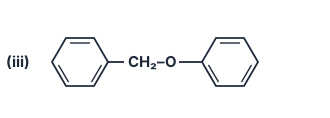
Q.Give the major products that are formed by heating each of the following ethers with HI.
You're viewing a preview — the full solution, concept, methods & PYQ mapping are locked.
Start your 14-day free trial to unlock the full solution →The key idea is that under acidic cleavage with HI, the C–O bond breaks at the less substituted carbon (via ) when possible, but for tertiary/benzylic groups the more substituted carbon gets the iodine (via ). A tertiary or benzylic alcohol byproduct reacts readily with further HI to give a second alkyl iodide, but a primary alcohol byproduct reacts much more slowly and is normally isolated as the alcohol itself.
Concept & Intuition
Heating an ether with concentrated HI is the classic acidic cleavage reaction. The mechanism is a two-step nucleophilic substitution: first the ether oxygen is protonated by HI, making it a good leaving group (as a neutral alcohol molecule). Then the iodide ion () attacks one of the carbon atoms adjacent to the oxygen.
The critical decision is which C–O bond breaks. This depends entirely on the structure of the alkyl groups attached to the oxygen.
- If both groups are primary or methyl, the reaction follows : the iodide attacks the less hindered (less substituted) carbon.
- If one group is tertiary, benzylic, or allylic, that carbon can form a relatively stable carbocation, so the reaction follows : the C–O bond breaks to give that carbocation, which is then trapped by iodide. In this case, the more substituted (or resonance-stabilised) carbon gets the iodine.
Common Mistake
Students often assume the larger alkyl group always gets the iodine. That is wrong — it is the less substituted carbon in and the more substituted carbon in . Always check the substitution pattern first.
(i)
Step 1: Identify the alkyl groups.
The ether is:
Left side: — this is a primary carbon (the carbon directly attached to oxygen is a group, even though the chain has a branch further away).
Right side: — this is also primary (ethyl group).
Step 2: Decide the mechanism.
Both groups are primary. No tertiary, benzylic, or allylic carbons. So the reaction proceeds via .
Step 3: Which bond breaks?
In , the iodide attacks the less hindered primary carbon. The right-side ethyl carbon is less hindered than the left-side carbon (which has a branched chain nearby), so the iodide attacks the ethyl carbon, breaking the bond.
Step 4: Write the products.
The oxygen stays with the more substituted fragment (the branched chain) as an alcohol, and the ethyl group leaves as ethyl iodide.
The resulting alcohol, 2-methylbutan-1-ol, is primary — primary alcohols react only slowly with HI (the substitution is comparatively sluggish), so under the conditions that cleave the ether it is normally isolated as the free alcohol rather than being converted on to a second iodide.
Final products:
(2-methylbutan-1-ol) and (iodoethane).
Shortcut
For ethers with two primary groups, the smaller alkyl group becomes the iodide; the larger (or more branched) alkyl group stays as the alcohol. Here ethyl is smaller than the C5 branched chain.
(ii)
Step 1: Identify the alkyl groups.
Left side: — this is a primary carbon (propyl).
Right side: — the carbon directly attached to oxygen is a tertiary carbon (it has three other carbon substituents: two methyls and one ethyl).
Step 2: Decide the mechanism.
One group is tertiary. The tertiary carbon can form a stable tertiary carbocation. So the reaction follows : the C–O bond breaks to give the tertiary carbocation, which is then attacked by iodide.
Step 3: Which bond breaks?
The bond that breaks is the one that gives the more stable carbocation — the tertiary carbon–oxygen bond. So the oxygen stays with the primary propyl group (as an alcohol), and the tertiary group becomes the iodide.
Step 4: Write the products.
First cleavage:
The resulting propan-1-ol is primary — like 2-methylbutan-1-ol in part (i), it reacts only sluggishly with HI under these conditions, so it is isolated as the free alcohol rather than being converted on to a second iodide.
Final products:
(propan-1-ol) and (2-iodo-2-methylbutane). …
Unlock everything free for 14 days
- Full step-by-step solutions
- Concept-first explanations
- Methods, shortcuts & mistakes
- PYQ mapping + timed mock tests
Full access for 14 days. No credit card required.