Chemistry · Ch 10 — Biomolecules
Amino Acids
Amino Acids
What makes a molecule an amino acid
An amino acid is any molecule carrying two functional groups at once: a basic amino group () and an acidic carboxyl group (). It is this dual acid–base identity, sitting on one small molecule, that gives amino acids nearly all of their distinctive chemistry.
The amino group does not have to sit on any particular carbon of the chain — it can be attached to the carbon next to the carboxyl carbon, or one further away, or further still. Amino acids are named according to exactly this relative position:
- -amino acid — the group is on the carbon immediately adjacent to the carbon
- -amino acid — one carbon further away
- -, -amino acids, and so on — progressively further along the chain
Of all these possibilities, only the -amino acids are the ones biology actually uses to build proteins — they are the sole type of amino acid released when a protein is broken down (hydrolysed). This is why, in the context of biomolecules, "amino acid" effectively means "-amino acid."
General structure
An -amino acid can be written generically as:
Here the amino and carboxyl groups both sit on the same () carbon, and is the "side chain" — the group that varies from one amino acid to the next and gives each amino acid its individual identity. A change in is the only thing that distinguishes glycine from alanine from tryptophan, and so on. Besides the amino and carboxyl groups, an -amino acid's side chain may itself carry other functional groups (a second , a second , an , an , an aromatic ring, and so on), and this variation is exactly what later allows amino acids to be sorted into acidic, basic and neutral types.
Naming and identification …
| Name of the amino acids | Characteristic feature of side chain, R | Three letter symbol | One letter code |
|---|---|---|---|
| 1. Glycine | Gly | G | |
| 2. Alanine | Ala | A | |
| 3. Valine* | Val | V | |
| 4. Leucine* | Leu | L | |
| 5. Isoleucine* | Ile | I | |
| 6. Arginine* | Arg | R | |
| 7. Lysine* | Lys | K | |
| 8. Glutamic acid | Glu | E | |
| 9. Aspartic acid | Asp | D | |
| 10. Glutamine | Gln | Q | |
| 11. Asparagine | Asn | N | |
| 12. Threonine* | Thr | T | |
| 13. Serine | Ser | S | |
| 14. Cysteine | Cys | C | |
| 15. Methionine* | Met | M | |
| 16. Phenylalanine* | Phe | F | |
| 17. Tyrosine | (p) | Tyr | Y |
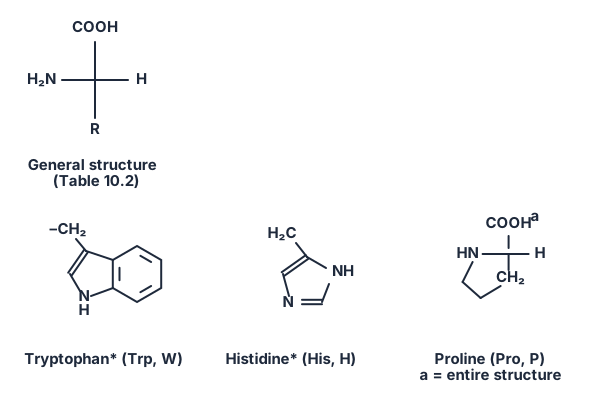
Drawn by us to help you understand the concept clearly, and verified to make sure it's accurate. For exams, practice from your textbook's own diagram.
Redrawn from the NCERT page with the structures, printed labels (COOH, H2N, –CH2, H2C, NH, HN, CH2) and reagent placement exactly as the textbook prints them. Every element of this display was checked against the printed page during the sweep's blind-judge verification pass, so …