Chemistry · Ch 10 — Biomolecules
Classification of Amino Acids
Classification of Amino Acids
Sorting amino acids by charge: acidic, basic and neutral
Beyond their individual side chains, amino acids can be grouped into three broad categories based on a simple count: how many amino groups versus how many carboxyl groups a given amino acid's structure carries overall (counting any extra or present on the side chain, in addition to the one pair that is always present on the -carbon).
- Neutral amino acids — the number of amino groups equals the number of carboxyl groups (typically one of each)
- Basic amino acids — amino groups outnumber carboxyl groups
- Acidic amino acids — carboxyl groups outnumber amino groups
This is a straightforward extension of the zwitterion picture from the previous section: an amino acid with an extra, uncompensated on its side chain has more negative-chargeable sites than positive ones, tilting it acidic overall (aspartic acid and glutamic acid, for instance); one with an extra, uncompensated tilts basic (lysine and arginine, for instance); and one with the two groups in balance is neutral.
Sorting amino acids by origin: essential and non-essential
A second, biologically important way of classifying amino acids has nothing to do with structure and everything to do with where the body gets them from:
- Non-essential amino acids — amino acids the human body is able to synthesise internally, from other precursors, and so does not strictly need to obtain from food.
- Essential amino acids — amino acids the human body cannot synthesise on its own. These must be supplied externally, through the diet, or a deficiency results.
In the standard reference table of the twenty natural amino acids, the essential ones are conventionally flagged with an asterisk, making it easy to see at a glance which amino acids a balanced diet must supply directly.
Physical behaviour: why amino acids act like salts
Amino acids are, in their pure form, colourless crystalline solids with unusually high melting points, and they dissolve readily in water. This is unusual: an ordinary carboxylic acid or an ordinary amine does not typically behave this way. The reason traces directly back to having both an acidic and a basic group on the same molecule.
In aqueous solution, an amino acid does not exist in the simple, electrically neutral-looking form . Instead, an internal acid–base reaction takes place within the molecule itself: the carboxyl group donates its proton, becoming the carboxylate ion , and the amino group accepts that proton, becoming the ammonium ion . The result is a dipolar structure called a zwitterion (from German Zwitter, "hybrid"):
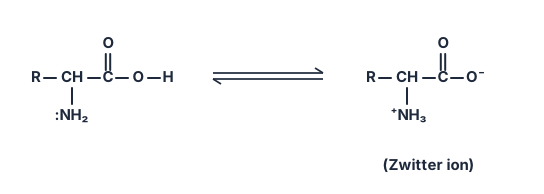
Drawn by us to help you understand the concept clearly, and verified to make sure it's accurate. For exams, practice from your textbook's own diagram.
Redrawn from the NCERT page with the structures, printed labels (CH, :NH2, O⁻, ⁺NH3) and reagent placement exactly as the textbook prints them. Every element of this display was checked against the printed page during the sweep's blind-judge verification pass, so wh …
The zwitterion carries both a positive and a negative charge at once, but because these two charges are equal and opposite, the molecule as a whole is electrically neutral.
This zwitterionic, internal-salt structure explains the physical behaviour described above: it is precisely why amino acids behave like salts rather than like typical amines or carboxylic acids — they are solids rather than liquids, they have high melting points, they dissolve well in a polar solvent like water, and they are poorly soluble in nonpolar organic solvents. All of these are hallmark properties of ionic/salt-like compounds, not of simple organic acids or amines.
Because the zwitterion still carries a free (which can accept a proton and act as a base) and a free (which can donate a proton and act as an acid), an amino acid in its zwitterionic form is amphoteric — capable of reacting as both an acid and a base depending on what it is placed with. …