Chemistry · Ch 10 — Biomolecules
Glucose
Glucose
Glucose is an aldohexose, and its everyday name in commerce and physiology is dextrose. It occurs freely in nature — sweet fruits, honey and ripe grapes are all rich in it — and also occurs in the combined form, since it is the monomeric building block of larger carbohydrates such as starch and cellulose. It is, in fact, probably the single most abundant organic compound on Earth.
Preparation of Glucose
1. From sucrose (cane sugar)
Boiling sucrose with dilute HCl or in an alcoholic solution hydrolyses it into equal amounts of glucose and fructose:
2. From starch
This is the commercial route. Starch (or cellulose) is boiled with dilute at 393 K under a pressure of 2–3 atmospheres, hydrolysing it fully down to glucose:
Working Out the Open-Chain Structure
Glucose's structure was not guessed — it was pieced together from a sequence of chemical evidence, each experiment ruling in or ruling out a structural feature.
1. Molecular formula. Elemental analysis and molecular-mass determination fixed the formula as .
2. A straight chain of six carbons. Prolonged heating of glucose with HI reduces it all the way down to n-hexane:
Since exhaustive reduction collapses the molecule into an unbranched six-carbon alkane, all six carbon atoms of glucose must be linked in a single straight chain — none of them are branch points.
3. A carbonyl group is present. Glucose reacts with hydroxylamine to form an oxime ( in place of ), and it also adds one molecule of hydrogen cyanide to form a cyanohydrin. Both reactions are classic tests for a carbonyl group, , so both confirm its presence in glucose.
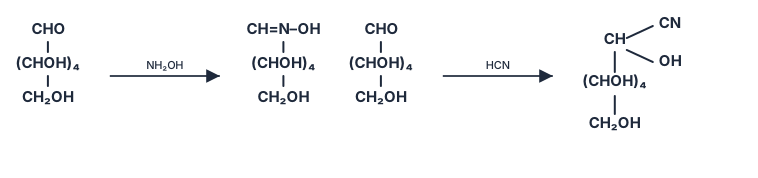
Drawn by us to help you understand the concept clearly, and verified to make sure it's accurate. For exams, practice from your textbook's own diagram.
Redrawn from the NCERT page with the structures, printed labels (CHO, (CHOH)4, CH2OH, CH=N–OH, CH, CN, OH) and reagent placement exactly as the textbook prints them. Every element of this display was checked against the printed page during the sweep's blind-judge verification pass, so …
4. The carbonyl is specifically an aldehyde, at the chain end. A mild oxidising agent — bromine water — oxidises glucose to a six-carbon carboxylic acid called gluconic acid. A ketone would not be oxidised this easily or this cleanly by a mild oxidant; that the terminal carbon is converted straight to a group shows the carbonyl is an aldehydic () group sitting at the very end of the chain.
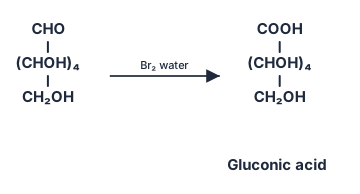
Drawn by us to help you understand the concept clearly, and verified to make sure it's accurate. For exams, practice from your textbook's own diagram.
Redrawn from the NCERT page with the structures, printed labels (CHO, (CHOH)4, CH2OH, COOH) and reagent placement exactly as the textbook prints them. Every element of this display was checked against the printed page during the sweep's blind-judge verification pass, so w …
5. Five –OH groups, each on a different carbon. Treating glucose with acetic anhydride acetylates it fully, giving glucose pentaacetate — five acetate groups are introduced. Since this pentaacetate is a stable compound, the five groups being esterified must all sit on different carbon atoms (a single carbon cannot stably carry more than one ).
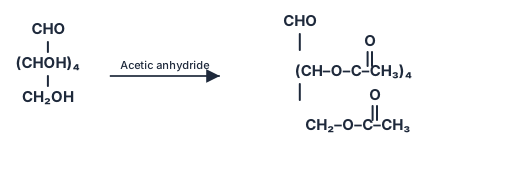
Drawn by us to help you understand the concept clearly, and verified to make sure it's accurate. For exams, practice from your textbook's own diagram.
Redrawn from the NCERT page with the structures, printed labels (CHO, (CHOH)4, CH2OH, (CH–O–C–CH3)4, CH2–O–C–CH3) and reagent placement exactly as the textbook prints them. Every element of this display was checked against the printed page during the sweep's blind-judge verification pass, s …
6. A primary alcohol group at the other end. Oxidising glucose with the stronger oxidant nitric acid converts it to a dicarboxylic acid, saccharic acid — and oxidising gluconic acid (from step 4) under the same conditions gives the same saccharic acid. Since gluconic acid already has a at C1, the only way both routes can land on a dicarboxylic acid is if the at the opposite end of the chain (C6) is a primary alcohol that nitric acid also oxidises to .
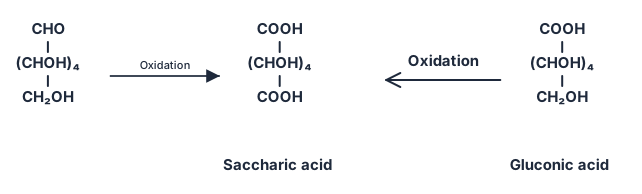
Drawn by us to help you understand the concept clearly, and verified to make sure it's accurate. For exams, practice from your textbook's own diagram.
Redrawn from the NCERT page with the structures, printed labels (CHO, (CHOH)4, CH2OH, COOH, Oxidation) and reagent placement exactly as the textbook prints them. Every element of this display was checked against the printed page during the sweep's blind-judge verification pass, so …
Put together, these six results fix glucose as a straight, unbranched six-carbon chain with an aldehyde group at C1, hydroxyl groups at C2 through C5, and a primary alcohol () at C6 — written in Fischer-projection style as:
Fixing the Stereochemistry — Fischer's Configuration
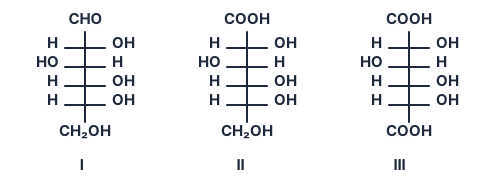
Knowing the connectivity is not the same as knowing the exact three-dimensional arrangement of each group. That precise spatial arrangement — the configuration — was worked out by Emil Fischer from a wider study of glucose's properties, and is written (top carbon = C1, most oxidised carbon drawn at the top) as:
Drawn by us to help you understand the concept clearly, and verified to make sure it's accurate. For exams, practice from your textbook's own diagram.
Redrawn from the NCERT page with the structures, printed labels (CHO, OH, HO, CH2OH, COOH) and reagent placement exactly as the textbook prints them. Every element of this display was checked against the printed page during the sweep's blind-judge verification pass, so wh …
| Carbon | Configuration I — Glucose | Configuration II — Gluconic acid | Configuration III — Saccharic acid |
|---|---|---|---|
| C1 | CHO | COOH | COOH |
| C2 | H–OH (OH right) | H–OH (OH right) | H–OH (OH right) |
| C3 | HO–H (OH left) | HO–H (OH left) | HO–H (OH left) |
| C4 | H–OH (OH right) | H–OH (OH right) | H–OH (OH right) |
| C5 | H–OH (OH right) | H–OH (OH right) | H–OH (OH right) |
| C6 | CH₂OH | CH₂OH | COOH |
Configuration I is glucose itself; oxidising C1 alone (bromine water) gives configuration II, gluconic acid; oxidising both ends (nitric acid) gives configuration III, saccharic acid — exactly matching the oxidation evidence above.
D and L notation
Glucose's full, correct name is D-(+)-glucose. The two symbols carry independent meanings that are easy to conflate:
- 'D' describes the molecule's configuration — the spatial arrangement of its groups.
- '(+)' describes its optical activity — here, that it rotates plane-polarised light to the right (dextrorotatory).
'D' and 'L' are not related to '(+)' and '(–)' (or to lowercase 'd' and 'l'). A compound with D-configuration can be dextrorotatory or laevorotatory; the two labels are independent and must be determined separately.
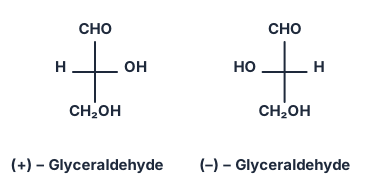
The D/L configurational label is assigned relative to glyceraldehyde, the simplest sugar with one asymmetric carbon, which exists as two enantiomers:
Drawn by us to help you understand the concept clearly, and verified to make sure it's accurate. For exams, practice from your textbook's own diagram.
Redrawn from the NCERT page with the structures, printed labels (CHO, OH, CH2OH, HO) and reagent placement exactly as the textbook prints them. Every element of this display was checked against the printed page during the sweep's blind-judge verification pass, so wh …
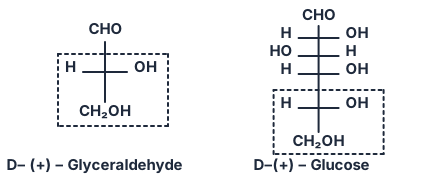
By convention, D-(+)-glyceraldehyde has its on the right when drawn with at the top. Any compound that can be chemically correlated to this D-(+)-glyceraldehyde is assigned D-configuration; any compound correlated instead to L-(–)-glyceraldehyde (OH on the left) is assigned L-configuration.
For a monosaccharide with several asymmetric carbons, only one of them is used for this comparison: the lowest asymmetric carbon — the one nearest the end, farthest from the most-oxidised carbon (which is conventionally drawn at the top of the structure). In D-(+)-glucose, that lowest asymmetric carbon is C5, and its points to the right, exactly matching D-(+)-glyceraldehyde — so glucose is assigned D-configuration. (The configuration at the other asymmetric carbons, C2–C4, plays no role in this particular comparison.)
Drawn by us to help you understand the concept clearly, and verified to make sure it's accurate. For exams, practice from your textbook's own diagram.
Redrawn from the NCERT page with the structures, printed labels (CHO, OH, CH2OH, HO) and reagent placement exactly as the textbook prints them. Every element of this display was checked against the printed page during the sweep's blind-judge verification pass, so wh …
Why the Open-Chain Structure Was Not the Whole Story
The open-chain structure explains most of glucose's reactions, but three observations resisted it completely:
What the open-chain (aldehyde) structure could not explain:
- Glucose fails Schiff's test, and it does not form the expected hydrogensulphite () addition product — both surprising for a molecule assumed to carry a free aldehyde group.
- Glucose pentaacetate does not react with hydroxylamine, implying there is no free group left in that form.
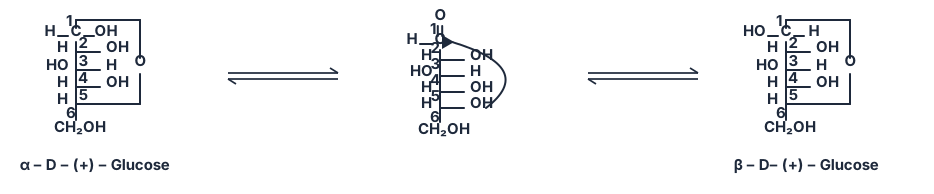
- Glucose is found to exist in two distinct crystalline forms, labelled and : the -form (m.p. 419 K) crystallises from a concentrated glucose solution at 303 K, while the -form (m.p. 423 K) crystallises from a hot, saturated aqueous solution at 371 K.
None of this fits a molecule that is simply an open chain ending in a free aldehyde. The resolution: one of the chain's own groups can add across the group intramolecularly, forming a cyclic hemiacetal. Specifically, the on C5 attacks the carbonyl carbon (C1), closing a six-membered ring. This single step explains both puzzles at once: the aldehyde carbon is now tied up in a hemiacetal linkage (so no free remains, resolving points 1 and 2), and the new hemiacetal carbon, C1, becomes a fresh stereocentre that can form in two different spatial arrangements — giving exactly the two crystalline forms of point 3. …
Drawn by us to help you understand the concept clearly, and verified to make sure it's accurate. For exams, practice from your textbook's own diagram.
Redrawn from the NCERT page with the structures, printed labels (OH, HO, CH2OH) and reagent placement exactly as the textbook prints them. Every element of this display was checked against the printed page during the sweep's blind-judge verification pass, so wha …
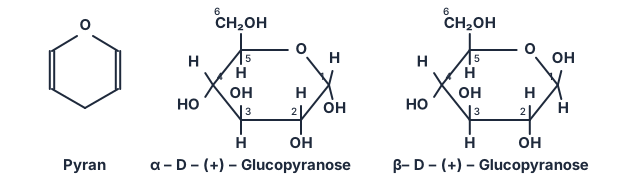
Drawn by us to help you understand the concept clearly, and verified to make sure it's accurate. For exams, practice from your textbook's own diagram.
Redrawn from the NCERT page with the structures and reagent placement exactly as the textbook prints them. Every element of this display was checked against the printed page during the sweep's blind-judge verification pass, so what you …